

Writing fiction sounds exciting until you face a blank page with no clear story idea, weak characters, or a plot that doesn’t move forward. AI writing tools for fiction can help you overcome these problems by giving you story ideas, character suggestions, plot ideas, and help with scenes and dialogue. You can use AI as a creative assistant while keeping your own writing style and ideas.
In this guide, we’ll look at the 10 best AI writing tools for fiction in 2026 and explain what each tool is best for. We compare them based on features such as story writing, character development, plot planning, editing, brainstorming, and long-form writing. Whether you’re writing a novel, short story, romance, fantasy, or thriller, this guide will help you choose a tool that fits your writing needs. AI can make writing easier, but your creativity, experience, and final decisions are what make your story truly yours.
ChatGPT – Best Overall AI Writing Tool for Fiction
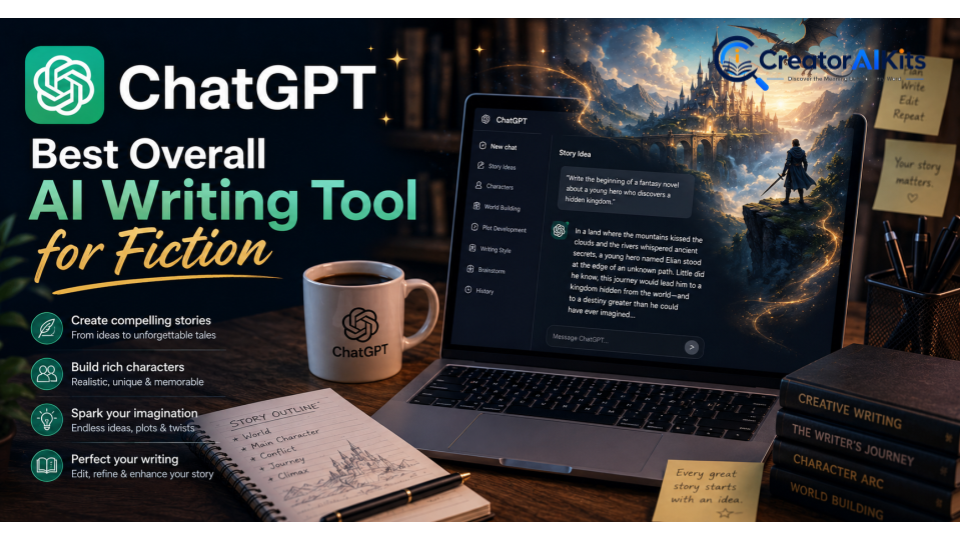
ChatGPT is one of the most flexible choices for writers who want help across the entire storytelling process. You can use it for story brainstorming, character creation, plot development, chapter planning, and scene writing. Instead of using it only as an AI story generator, you can treat it like a writing partner that helps you explore different directions before you commit to an idea.
For example, you could provide a basic concept such as, “A detective discovers that every crime scene predicts the next victim.” ChatGPT can help turn that idea into a story outline, develop the detective’s personality, suggest conflicts, and build narrative tension. It can also help when writer’s block strikes because you can ask for several possible plot paths instead of forcing yourself to find one perfect idea.
Story Ideas and Brainstorming
ChatGPT works especially well when you have a vague concept but don’t know where to take it. You can ask for unusual story ideas, character conflicts, plot twists, fictional settings, or fiction writing prompts based on your preferred genre.
It can also help you brainstorm alternatives. For example, a romance writer might ask for three different ways two characters could meet, while a thriller writer could request several escalating conflicts. This makes it useful as an AI brainstorming tool throughout the early stages of story development.
Character Development
Strong characters need more than names and descriptions. They need goals, fears, motivations, flaws, relationships, and believable changes throughout the story. ChatGPT can help you create detailed character profiles and explore how a character might react under pressure.
You can also use it to improve character consistency. Give the AI information about a character’s personality and background, then ask it to suggest reactions that fit those traits. You should still review the suggestions because your own understanding of the character should remain the final authority.
Plot Creation and Scene Writing
ChatGPT can help transform a basic premise into a structured story. You can ask for a three-act structure, chapter-by-chapter outline, subplot ideas, turning points, or possible endings. It can also expand a short scene concept into a fuller sequence with setting details, conflict, dialogue, and emotional depth.
For fiction writers, this flexibility makes ChatGPT useful from the first idea to the final revision. It can support plot generation, scene expansion, dialogue generation, and rewriting while allowing you to decide which ideas belong in your story.
Claude – Best for Long-Form Fiction and Story Development
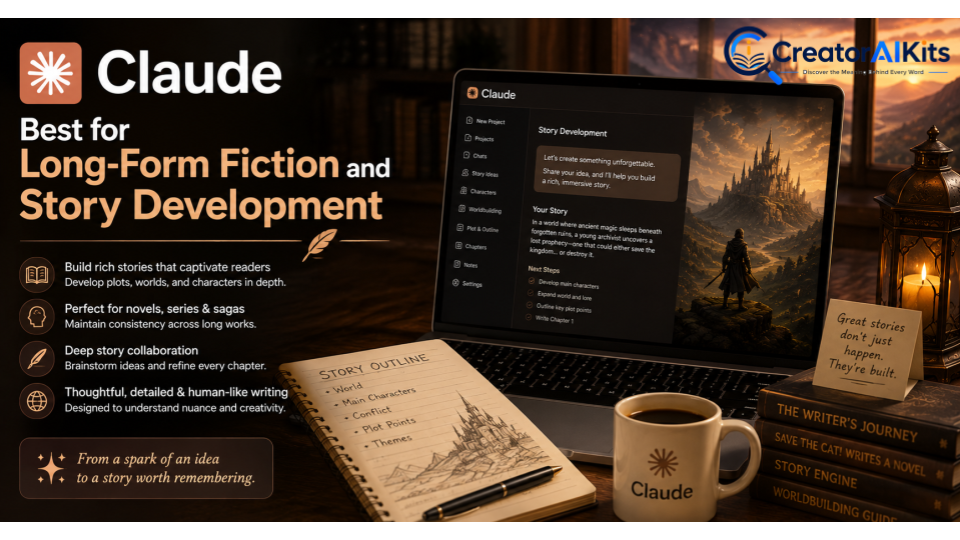
Claude is particularly useful when your project involves substantial amounts of text and requires attention to broader story context. Fiction writers often need to work with character notes, previous chapters, outlines, and detailed instructions at the same time. A long-context AI can make this type of workflow easier because you can provide more background before asking for feedback or revisions.
Claude can also help with story development beyond simple text generation. You can ask it to examine whether a character’s motivation makes sense, identify inconsistencies in a plot, suggest improvements to pacing, or compare a new scene with earlier events. This makes it valuable for writers who want an AI writing assistant that can participate in both creation and revision.
Long-Context Writing
Long-form writing creates a common problem: details introduced early in a story can become difficult to track later. Names, relationships, motivations, locations, and important events all need to remain consistent. Claude’s ability to work with large amounts of context can help you review these elements together.
For example, you can provide a story outline and several chapters before asking for continuity feedback. The tool can then help identify places where a character behaves differently from the established characterization or where an event conflicts with your earlier story structure.
Story Structure
A good novel needs more than interesting individual scenes. Those scenes must work together to create a meaningful story structure. Claude can help you examine the relationship between the opening hook, rising conflict, midpoint developments, climax, and resolution.
You can also use it for chapter planning. Give it your central premise and major characters, then ask for possible chapter sequences. Rather than accepting the first outline automatically, compare different versions and choose the structure that best fits your narrative style.
Editing and Rewriting
Claude can be useful when your first draft exists but needs refinement. You can ask it to identify repetitive wording, improve clarity, strengthen transitions, or suggest ways to increase emotional depth. It can also help with rewriting scenes while preserving the original meaning.
This makes Claude more than a generation tool. For authors who already have substantial material, it can function as an AI editing tool and brainstorming partner. The strongest results usually come when you provide clear instructions about what should change and what must remain untouched.
Sudowrite – Best AI Writing Tool for Fiction Authors
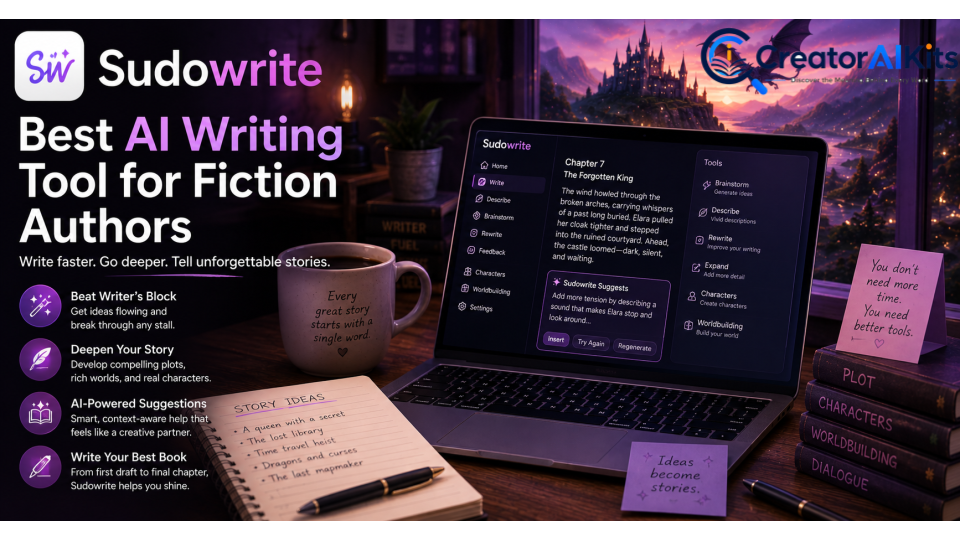
Sudowrite is designed specifically around the needs of fiction writers. Unlike general-purpose AI assistants, its workflow focuses heavily on storytelling, creative development, descriptions, characters, and scenes. That specialized approach makes it particularly appealing to authors who want tools built around the actual process of writing fiction.
The platform can help when you know what should happen in a scene but struggle to put the moment into words. It can also help you explore descriptions, generate possibilities, and develop story material while you remain in control of the final prose. For writers working on novels or short stories, that makes it a strong option for AI-assisted writing.
Creative Story Generation
Sudowrite can help you move from a basic concept to a more developed story. You might begin with a character, conflict, setting, or single sentence and then explore different ways the narrative could continue.
This approach is useful during creative brainstorming because you don’t need to know the complete story before you start. You can test different possibilities, discard weak ideas, and build on the ones that feel promising.
Descriptive Writing
Descriptions can make fictional scenes feel vivid, but writing them repeatedly can become challenging. Sudowrite can help you explore sensory details, atmosphere, setting descriptions, and different ways to portray the same moment.
For example, a simple sentence describing an abandoned house could become the starting point for several atmospheric directions. You might want the house to feel frightening, mysterious, nostalgic, or strangely peaceful. Exploring those options can help you find a description that matches your intended writing tone.
Character and Scene Development
A strong scene usually needs a purpose. Sudowrite can help you explore what a character wants during a scene, what stands in the way, and how the situation might change by the end. This can make scene writing more focused rather than simply adding words to the manuscript.
It’s also useful for character development because you can experiment with different reactions, internal thoughts, and emotional responses. Writers should still make the final decisions so the characters retain a distinctive voice instead of sounding like generic AI-generated fiction.
NovelAI – Best for AI-Assisted Novel Writing
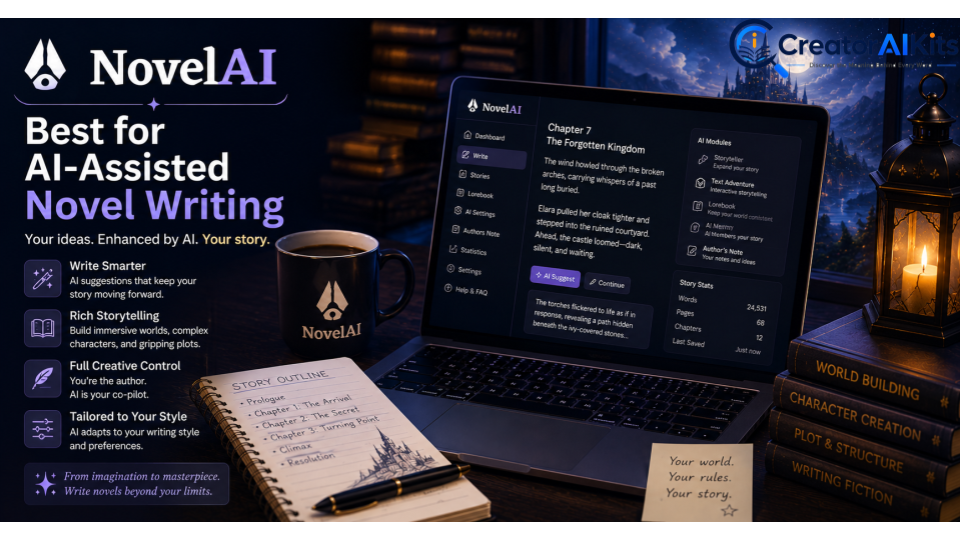
NovelAI is built with storytelling and long-form creative writing in mind. It can appeal to writers who want a dedicated environment for developing fictional stories, characters, and worlds. Its focus makes it especially relevant for authors working on genre fiction and longer projects.
The platform can be particularly interesting for writers who enjoy detailed fictional settings. Fantasy and science fiction authors often need to track places, characters, lore, rules, and relationships across many chapters. A dedicated storytelling environment can help organize those elements while you continue developing the manuscript.
Fiction Storytelling
NovelAI can assist with continuing fictional passages, exploring story directions, and developing narrative ideas. Instead of starting every section from an empty page, you can use the tool to explore possible continuations and then shape the output into your own writing.
This can be useful when you have a clear story concept but need help generating momentum. You can experiment with different narrative directions and choose the one that fits your intended story structure and writing style.
Character Creation
Character creation becomes easier when you think beyond basic appearance. A believable character needs a personality, background, motivations, relationships, strengths, weaknesses, and internal conflicts.
NovelAI can help you explore these elements while developing fictional characters. You can create character concepts and use them as a foundation for future scenes. As with any AI character generator, however, you should refine the results so your characters feel original and emotionally believable.
Worldbuilding
Worldbuilding is one of the biggest challenges in fantasy and science fiction writing. A fictional world may require its own geography, cultures, history, political systems, technology, magic, languages, and social rules.
NovelAI can support this process by helping you brainstorm fictional worlds and organize ideas around them. Concepts such as a story bible or lorebook can become useful when your project contains many interconnected details. The goal isn’t to let AI invent everything. Instead, use it to explore possibilities while you define the rules that make your world unique.
Jasper – Best for Creative Writing and Story Ideas
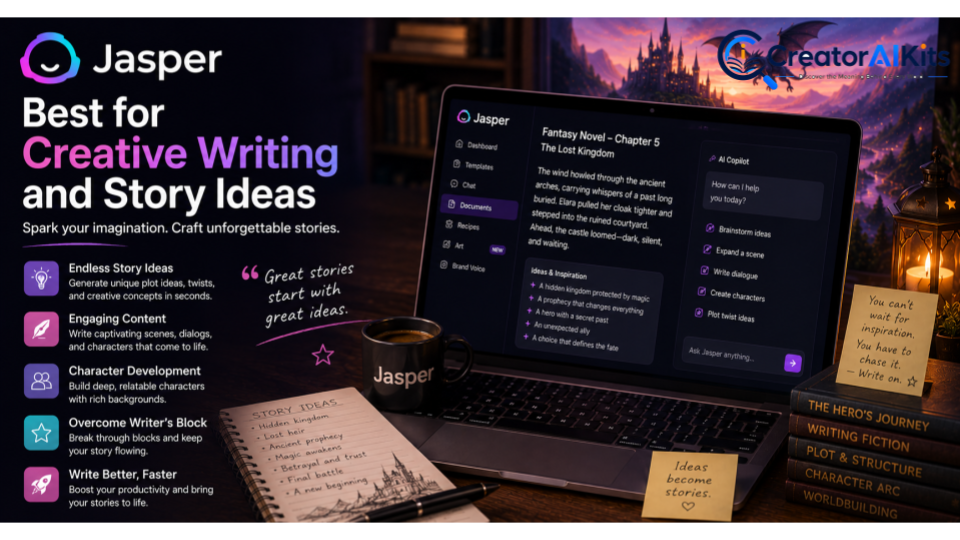
Jasper is widely known as an AI writing platform, but it can also support creative writers during the idea and drafting stages. It can help generate concepts, prompts, variations, and early writing material when you need a starting point.
For fiction writers, its biggest value may come from reducing the friction between an idea and a first draft. You can begin with a rough concept and explore different angles before deciding which direction deserves more attention.
Story Concepts
A single story concept can lead to dozens of possible narratives. Jasper can help you explore those possibilities by generating variations around a central premise, theme, or genre.
For instance, you might have an idea about a woman who receives letters from her future self. You could explore whether the story works better as a romance, mystery, science fiction story, or psychological thriller. This type of brainstorming can reveal directions you hadn’t considered.
Creative Prompts
Creative prompts can be useful when you want to practice writing or escape a creative rut. Jasper can help generate prompts around characters, conflicts, settings, relationships, and unexpected situations.
These prompts can also become exercises rather than final story material. Write your own version first, then use AI to explore alternative approaches. This keeps the creative process centered on your imagination.
Writing Assistance
Jasper can provide writing assistance when you need to develop an early draft or explore different ways to express an idea. You can use it for paragraphs, descriptions, story openings, or variations of a scene.
However, fiction requires a consistent voice. Treat the generated text as raw material rather than a finished manuscript. Your editing, judgment, and personal style should shape the final version.
Google Gemini – Best for Fiction Research and Brainstorming
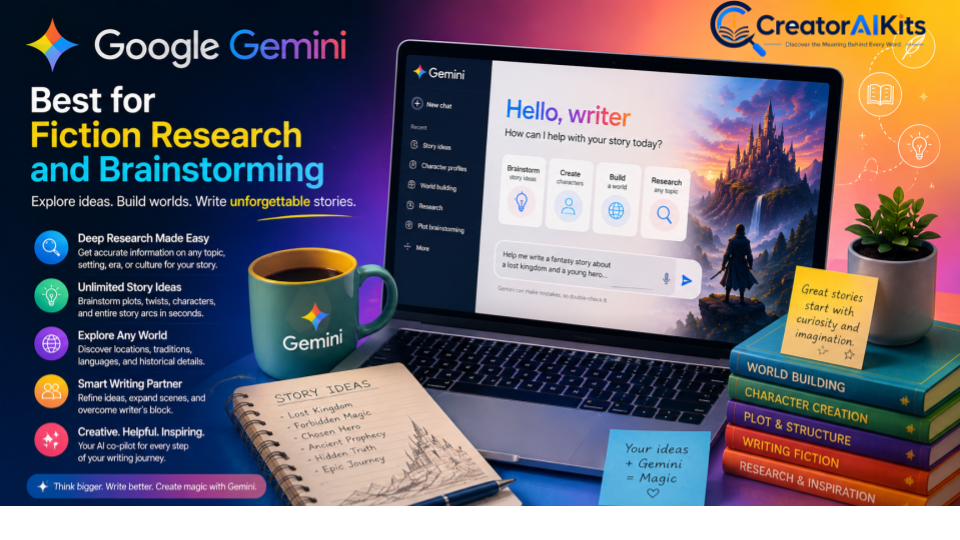
Google Gemini can be useful for fiction writers who need both creative brainstorming and research support. Many stories require background information about places, historical periods, scientific concepts, professions, cultures, or technologies. Research can make fictional writing more convincing, especially when your story depends on details outside your personal experience.
Gemini can also support early-stage story development. You can use it to brainstorm premises, character motivations, conflicts, settings, and possible plot directions. When research and creativity overlap, having one tool that can help with both can simplify your workflow.
Story Research
Research is often the hidden foundation of believable fiction. A historical novel may require knowledge of clothing, transportation, social customs, or everyday life. A science fiction story might require research into space travel, biology, computing, or future technologies.
Gemini can help you identify information to investigate and organize research questions. Always verify important factual details with reliable primary or authoritative sources, especially when accuracy matters.
Plot Ideas
When you’re stuck on plot development, Gemini can generate alternative conflicts, twists, obstacles, and endings based on your premise. You can also ask it to challenge your existing idea instead of simply adding more content.
For example, if your protagonist has already solved the central mystery too early, ask for ways to create a new complication. This turns AI into a creative problem-solving partner rather than a machine that simply writes more paragraphs.
Character Brainstorming
Character brainstorming can benefit from multiple perspectives. Gemini can help you explore personality traits, motivations, relationships, secrets, internal conflicts, and possible character arcs.
You can then select the strongest ideas and combine them with your own concepts. This approach helps you build more layered characters without allowing the AI to determine every part of their identity.
Grammarly – Best for Editing Fiction Writing
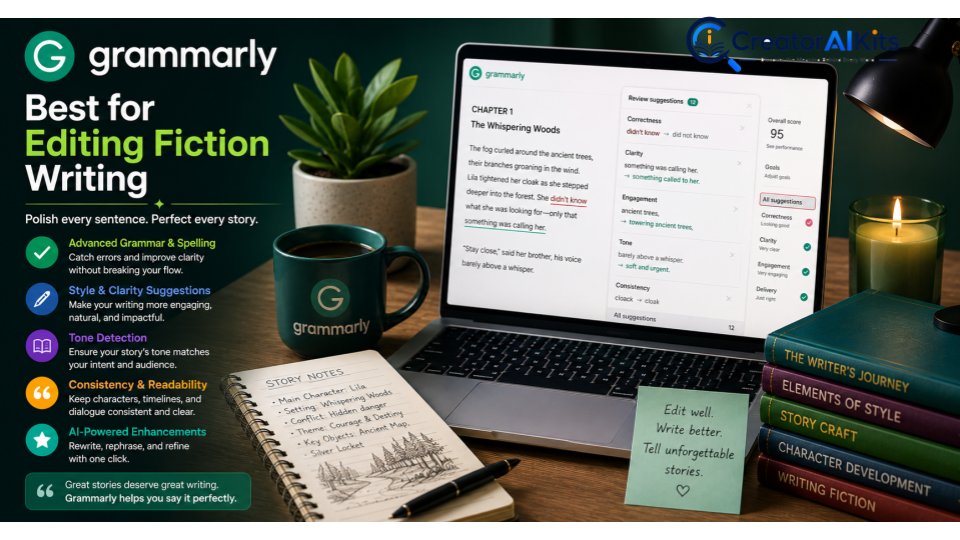
Grammarly serves a different role from dedicated story-generation platforms. Instead of focusing primarily on creating entire fictional narratives, it can help you polish existing writing. That makes it particularly useful after you’ve completed a scene, chapter, or draft and want to improve its clarity and correctness.
Fiction editing requires more than fixing grammar. You also need to protect voice, tone, rhythm, dialogue, pacing, and emotional impact. Grammarly can help with language-level improvements, but you should make the final creative decisions yourself.
Grammar Checking
Even strong writers make grammar and punctuation mistakes during a fast first draft. Grammarly can help identify common errors that might distract readers from the story.
This is especially helpful during the proofreading stage. After you’ve focused on characters, plot development, and emotional depth, an editing pass can catch smaller language problems before publication.
Style Improvement
Style suggestions can help you identify awkward phrasing, unnecessary repetition, and unclear sentences. For fiction, though, you shouldn’t automatically accept every suggestion.
Sometimes a fragmented sentence is intentional. A repeated word may create emphasis. A strange sentence structure may reflect a character’s voice. Good fiction editing knows when to follow a rule and when to break it.
Clarity and Readability
Grammarly can also help make difficult passages easier to understand. This matters when a sentence contains too many ideas or when the meaning becomes unclear.
Use these suggestions as a second pair of eyes rather than an automatic rewrite button. Your goal isn’t to make every sentence sound identical. Your goal is to make the story easier to experience while preserving your unique narrative style.
Copy.ai – Best for Fiction Ideas and Creative Content
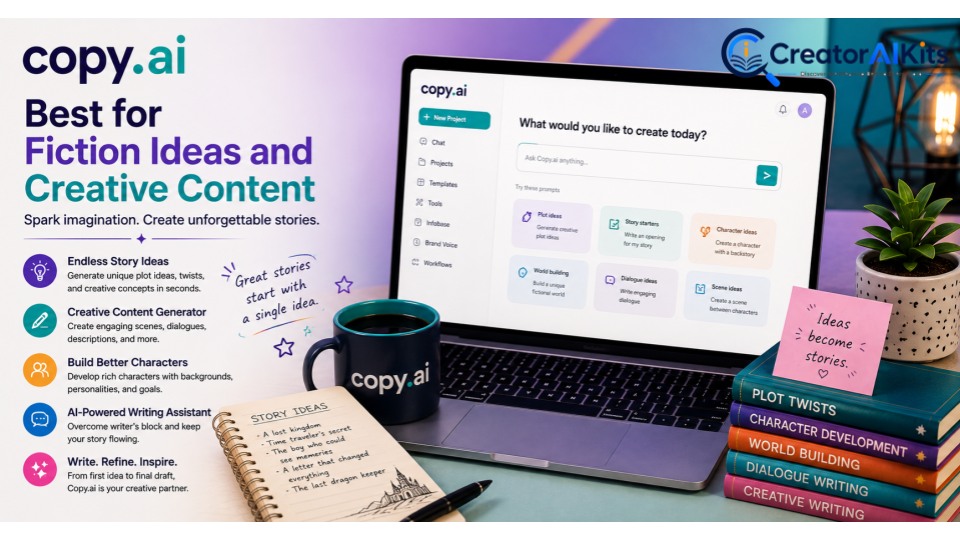
Copy.ai is better known for marketing and content workflows, but its generative capabilities can also help fiction writers explore ideas and develop early drafts. It can be useful when you want several variations of a concept rather than a single answer. For writers who like experimenting, that flexibility can turn one basic premise into multiple possible story directions.
It isn’t as specialized for fiction as platforms such as Sudowrite, so it makes more sense as a supporting AI story creator than as a complete novel-writing environment. Current comparisons also place Copy.ai more strongly in marketing and workflow use cases than dedicated fiction writing.
Story Prompts
A strong prompt can give you a starting point when your imagination feels stuck. Copy.ai can help generate situations, character conflicts, settings, and opening ideas based on a genre or theme.
For example, you could ask for mystery prompts involving a missing painting, an unreliable narrator, and a small coastal town. You can then select the idea that interests you most and develop it yourself. This makes the tool useful for overcoming writer’s block without requiring you to use every generated idea.
Creative Brainstorming
Creative brainstorming works best when you treat AI as a source of possibilities rather than an authority. Copy.ai can help you explore different character motivations, conflicts, twists, and endings around the same premise.
You can also ask for contrasting versions. A single story could become a dark thriller, a light romance, or a psychological mystery depending on the choices you make. This kind of experimentation helps you discover which narrative style feels right for your project.
Writing Variations
Sometimes the problem isn’t knowing what to write. It’s finding the right way to write it. Copy.ai can help generate different versions of a scene, opening paragraph, description, or dialogue exchange.
You might ask for a tense version, an emotional version, and a humorous version of the same moment. Comparing those variations can help you identify the tone that best fits your characters and story. Still, your own editing should shape the final prose so it doesn’t lose your individual writing voice.
Writesonic – Best for Creative Story Generation
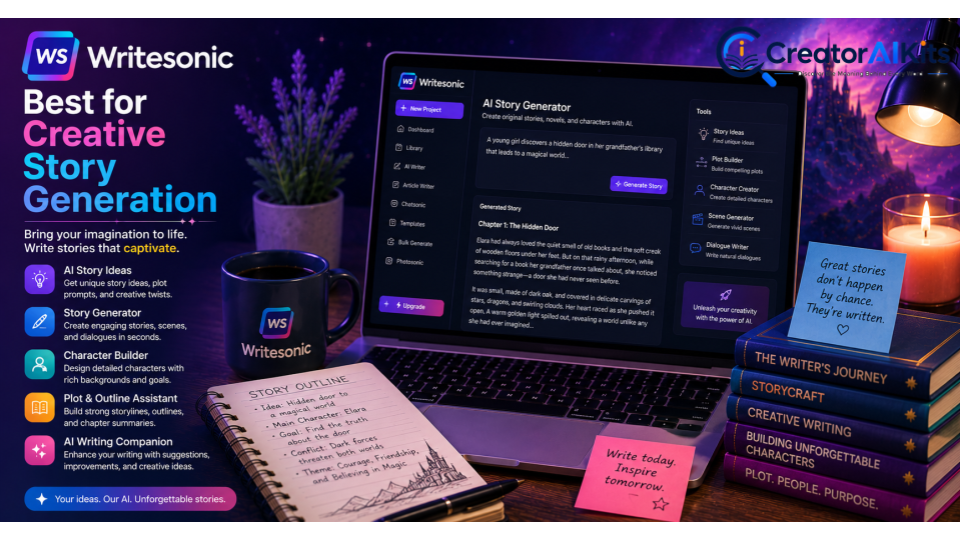
Writesonic is a broad AI writing platform that supports multiple forms of content creation. It isn’t primarily designed for novelists, but its generation and rewriting capabilities can still help writers during early story development. Current 2026 comparisons generally position Writesonic more strongly around content and SEO workflows, so fiction writers should view it as a flexible secondary tool rather than a dedicated fiction platform.
For short creative projects, brainstorming, and rough drafts, it can provide a useful starting point. You can develop an idea, experiment with different structures, and then move the strongest material into your main writing environment.
Story Outlines
A story outline gives you a map before you start writing hundreds of pages. Writesonic can help turn a basic premise into a sequence of events, characters, conflicts, and possible resolutions.
You can also use it to create alternative outlines. One version might focus heavily on character development while another emphasizes action and plot development. Comparing those approaches can help you decide what kind of story you actually want to tell.
Content Generation
Writesonic can generate early material from prompts and descriptions. This can be helpful when you need a rough scene, character introduction, setting description, or story opening.
However, generated content should be treated as draft material. Fiction depends heavily on voice, subtext, pacing, and emotional depth. Those qualities often need careful human revision rather than simple generation.
Fiction Writing Assistance
Writers can use Writesonic as a supporting AI writing assistant for brainstorming and rewriting. It may be useful when you want to test several ways of presenting an idea before deciding which one belongs in your manuscript.
For serious long-form fiction, compare it with tools specifically designed for novelists. Dedicated fiction platforms tend to offer features that focus more directly on narrative continuity and creative writing workflows.
Rytr – Best Budget-Friendly AI Writing Tool for Fiction
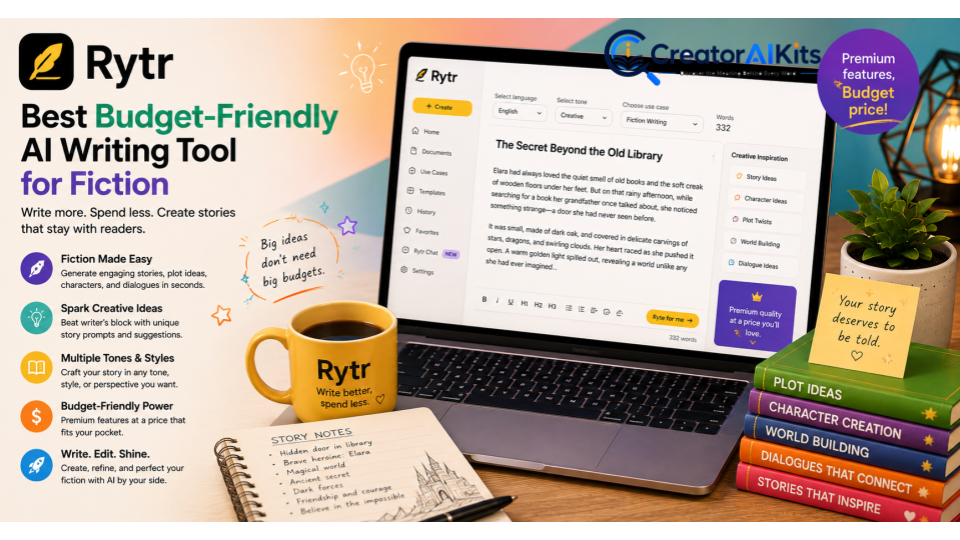
Rytr is a practical choice for writers who want basic AI assistance without committing to a more specialized fiction platform. It can help generate short drafts, prompts, ideas, and variations quickly. That makes it useful for beginners who want to experiment with AI-assisted writing before building a more advanced workflow.
Its main advantage is simplicity. You don’t need a complicated system to start brainstorming with it. Current 2026 comparisons continue to position Rytr as a budget-friendly AI writing option, although its fiction capabilities are less specialized than dedicated storytelling platforms.
Fiction Prompts
Rytr can help you generate fiction writing prompts when you need a quick creative push. You can specify a genre, character type, setting, or conflict and use the results as writing exercises.
This is particularly helpful for new writers who want to practice regularly. Instead of waiting for the perfect idea, you can generate a prompt and challenge yourself to turn it into a complete scene or short story.
Character Ideas
Character creation doesn’t always require a complicated system. Sometimes you simply need a fresh personality, unusual background, or interesting conflict.
Rytr can provide quick character concepts that you can develop further. For example, you could ask for a character whose greatest strength becomes their biggest weakness. That simple concept can lead to meaningful character development once you add your own motivations and backstory.
Quick Story Drafts
Rytr can help you get words onto the page quickly. That’s useful when your biggest obstacle is staring at an empty document.
Don’t expect a short AI-generated draft to become a finished story without substantial editing. Use it as raw material. Add your own scenes, details, dialogue, emotions, and narrative choices to turn the basic draft into something personal.
Best AI Writing Tools for Different Types of Fiction
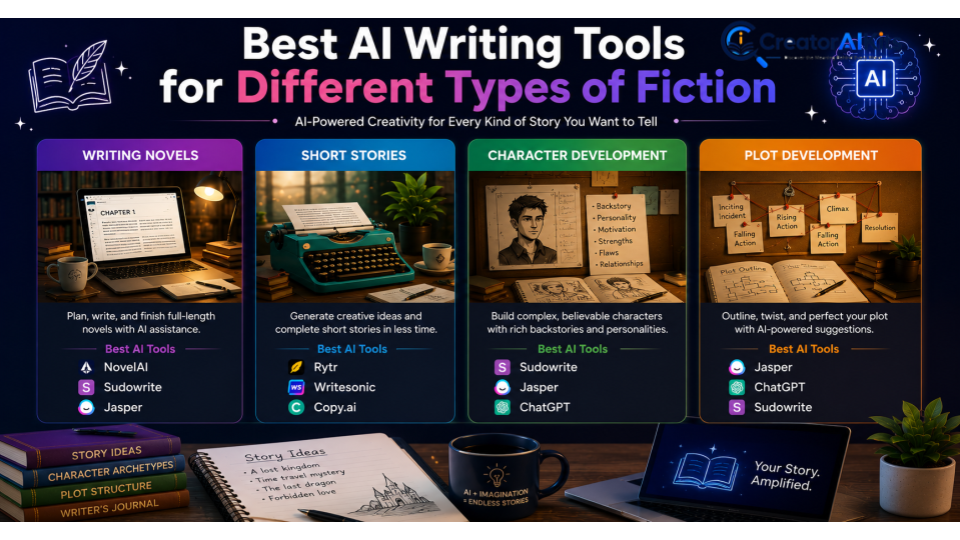
There isn’t one perfect AI tool for every kind of fiction. A novelist may care about long-form writing and context memory, while a short-story writer may value speed and brainstorming. A fantasy author may prioritize worldbuilding, whereas a romance writer may care more about character chemistry and realistic dialogue.
The best approach is to match the tool to the specific part of storytelling you find difficult. Dedicated fiction platforms tend to focus more closely on narrative workflows, while general AI assistants offer greater flexibility across different tasks.
Best AI Tool for Writing Novels
For novel writing, Claude, Sudowrite, and NovelAI are strong options to consider, while ChatGPT remains useful for outlining and brainstorming. The right choice depends on whether you need long-context analysis, scene-level creative assistance, or a dedicated fictional storytelling environment.
A novel requires consistency across many chapters. Characters need to behave according to their established personalities, plot events need to connect logically, and details introduced early shouldn’t randomly disappear later. For that reason, don’t choose a tool based only on how impressive its first paragraph sounds. Look at how well it fits your entire writing workflow.
Best AI Tool for Short Stories
Short story writers often need speed more than complex manuscript management. ChatGPT, Sudowrite, Gemini, and Rytr can all be useful for generating story ideas, outlining a compact narrative, developing a central conflict, and polishing scenes.
The shorter format also makes experimentation easier. You can test several endings or narrative styles without committing weeks to each version. AI works particularly well here as a brainstorming partner because you can rapidly compare possibilities before writing your final story.
Best AI Tool for Character Development
ChatGPT, Claude, Sudowrite, and NovelAI can all support character development. You can use them to explore personality traits, motivations, fears, relationships, flaws, goals, and character arcs.
The key is to build characters from the inside out. Don’t stop at appearance or occupation. Ask what your character wants, what they fear losing, what they believe about themselves, and what event could force them to change. Those answers create stronger foundations for believable storytelling.
Best AI Tool for Plot Development
ChatGPT and Claude are particularly useful for brainstorming plot structures, conflicts, twists, and alternative endings. Sudowrite can also be valuable when plot development needs to connect closely with scenes and prose.
A good AI plot generator shouldn’t decide your entire story for you. Instead, use it to challenge your assumptions. Ask what could go wrong, where the tension might drop, whether the protagonist has enough motivation, or how the antagonist could create a stronger obstacle.
AI Writing Tools for Fiction: Comparison Table
The tools below serve different purposes, so the “best” option depends on your workflow. Dedicated fiction tools generally provide a more specialized storytelling experience, while general-purpose assistants offer broader brainstorming and writing flexibility.
| AI Tool | Best For | Characters | Plot | Editing | Long-Form Fiction | Budget |
| ChatGPT | Overall fiction writing | ✓ | ✓ | ✓ | ✓ | Free/Paid |
| Claude | Long-form story development | ✓ | ✓ | ✓ | ✓ | Free/Paid |
| Sudowrite | Fiction authors | ✓ | ✓ | ✓ | ✓ | Paid |
| NovelAI | Novel writing & worldbuilding | ✓ | ✓ | — | ✓ | Paid |
| Jasper | Creative ideas | ✓ | ✓ | ✓ | ✓ | Paid |
| Google Gemini | Research & brainstorming | ✓ | ✓ | ✓ | ✓ | Free/Paid |
| Grammarly | Fiction editing | — | — | ✓ | — | Free/Paid |
| Copy.ai | Ideas & variations | ✓ | ✓ | ✓ | — | Free/Paid |
| Writesonic | Creative content | ✓ | ✓ | ✓ | ✓ | Free/Paid |
| Rytr | Budget-friendly drafts | ✓ | ✓ | ✓ | — | Free/Paid |
No single platform dominates every category. Current 2026 comparisons similarly emphasize that general assistants, dedicated fiction tools, and editing platforms serve different parts of the writing process.
How to Choose the Best AI Writing Tool for Fiction
Choosing an AI tool becomes easier when you focus on your actual writing problems. Don’t simply pick the platform with the longest feature list. Think about what you need most: ideas, outlining, prose generation, character development, editing, research, or long-form continuity.
A useful workflow may even combine two tools. For example, you could use a general AI assistant for brainstorming and planning, a dedicated fiction tool for scene development, and an editing tool for polishing the finished manuscript. This approach reflects the reality that different AI platforms specialize in different stages of writing.
Consider Your Writing Style
Your writing style should influence your choice. If you enjoy writing every sentence yourself but need help with ideas, choose a tool that works well for brainstorming. If you prefer AI-assisted drafting, look for stronger scene-generation and prose features.
Genre matters too. A fantasy writer may need extensive worldbuilding, while a romance writer may focus more on relationships and emotional writing. A thriller writer might prioritize pacing, suspense, and narrative tension.
Check Long-Form Writing Capabilities
Long-form fiction creates challenges that don’t appear in a 500-word story. A novel contains thousands of details that need to remain connected.
Look for tools that can handle substantial context and support organized story development. Claude, Sudowrite, and NovelAI are worth considering when long-form projects are your priority, although their workflows differ.
Look at AI Editing and Rewriting Features
Generation is only one part of writing. Good fiction often emerges through rewriting, cutting, rearranging, and polishing.
An AI editing tool can help identify unclear sentences, repetitive language, weak transitions, and grammatical problems. Grammarly can be useful at this stage, while general AI assistants such as ChatGPT and Claude can provide deeper feedback on scenes, structure, and characterization.
Compare Free and Paid Plans
Before paying for an AI writing platform, test whether its workflow actually suits you. Free access can help you understand the interface and output quality, while paid plans may offer higher limits or additional capabilities.
Don’t choose a subscription simply because it has more features. A simple tool that fits your writing process can be more valuable than an expensive platform you rarely use.
FAQs
What is the best AI writing tool for fiction in 2026?
There isn’t one universal winner. ChatGPT is a strong overall option, while Sudowrite is especially focused on fiction and Claude is useful for long-form story development.
Can AI writing tools help write an entire novel?
Yes, AI can help with outlining, characters, scenes, dialogue, rewriting, and editing. However, human direction and revision remain essential for consistency and originality.
What is the best AI tool for character development?
ChatGPT, Claude, Sudowrite, and NovelAI can all help develop characters. Your choice should depend on whether you need brainstorming, scene-level development, or a dedicated fiction workflow.
Which AI writing tool is best for worldbuilding?
NovelAI is a strong option for dedicated fictional worldbuilding, while ChatGPT and Claude are useful for brainstorming complex worlds, lore, and story systems.
Can AI-generated fiction still sound original and human?
Yes, but the final result depends heavily on your direction and editing. Use AI for ideas and assistance, then add your own voice, experiences, choices, and creative judgment.
Conclusion
The best AI writing tool for fiction depends on what you want help with. ChatGPT offers broad flexibility, Claude works well for long-form development, Sudowrite focuses heavily on fiction, NovelAI supports storytelling and worldbuilding, and Grammarly shines during editing. The other tools can also be useful when you need specific support for brainstorming, quick drafts, or creative experimentation.
Think of AI as a writing partner rather than a replacement for the author. The strongest stories still need human imagination, emotional judgment, distinctive characters, and a clear creative voice. Choose the tool that solves your biggest writing challenge, then use it to make your storytelling process faster and more creative

Welcome to CreatorAIKits! I’m passionate about learning and exploring AI tools, creativity, and technology.
I’m continuously researching and gaining hands-on experience with different AI tools and technologies.
My goal is to share simple, useful, and practical AI information for beginners and everyday users.
Thanks for visiting CreatorAIKits!