
E-commerce search is changing rapidly. Shoppers are no longer relying only on traditional Google search results to discover products. Increasingly, they are asking AI-powered platforms such as ChatGPT, Google AI, Gemini, Perplexity, and other answer engines to recommend products, compare brands, explain features, and help them decide what to buy.
This creates a new challenge for online stores: being visible in traditional search is no longer the entire visibility strategy.
Your products also need to be understandable, trustworthy, and discoverable by AI systems. AI optimization tools can help businesses monitor how their brands and products appear in AI-generated answers, identify competitors that are being recommended instead, analyze citations, and find opportunities to improve website content and product information.
However, not every AI visibility platform does the same thing. Some focus mainly on monitoring brand mentions. Others provide technical audits, content optimization, product-level insights, citation tracking, or enterprise reporting.
In this guide, we compare the 10 best AI optimization tools for e-commerce visibility in 2026, including their key features, pricing, strengths, limitations, and ideal use cases. The goal is to help you choose a platform based on your actual e-commerce needs rather than simply choosing the tool with the longest feature list.
Important: Pricing and features can change frequently in this emerging software category. Prices below reflect publicly available information checked in August 2026 and should be verified on the vendor’s website before purchasing.
What Are AI Optimization Tools for E-commerce?
AI optimization tools help businesses understand and improve their visibility in AI-generated search results and recommendations.
Traditional SEO tools usually focus on metrics such as:
- Google keyword rankings
- Organic traffic
- Backlinks
- Technical SEO errors
- Search volume
- Click-through rates
AI visibility tools look at a different question:
“When a potential customer asks an AI platform what to buy, does my brand or product appear?”
Depending on the platform, AI optimization software can track:
- Brand mentions
- Product recommendations
- AI citations
- Competitor visibility
- Share of voice
- Sentiment
- Search prompts
- Product information
- Technical AI-readiness
- Content opportunities
- AI-generated answers
This makes AI optimization a useful extension of SEO rather than a replacement for it.
Why AI Visibility Matters for E-commerce in 2026
Imagine a customer searches:
“What are the best running shoes for beginners under $150?”
Instead of browsing ten blue links, the customer may ask an AI assistant and receive a short list of recommended products.
If your competitor’s products appear but yours do not, you may lose that customer before they ever visit Google or your website.
This is why e-commerce businesses need to monitor AI visibility alongside traditional organic search.
Google itself describes its generative AI search experiences as being built on its existing Search systems, which means strong fundamentals such as useful content, technical accessibility, clear information, and trustworthy sources still matter.
The goal is not to “trick” AI systems into mentioning a product. The better strategy is to make your product information accurate, useful, accessible, well-structured, and supported by credible sources.
Quick Comparison: Best AI Optimization Tools for E-commerce
| Tool | Best For | Key Strength | Starting Price* |
| ZipTie | Technical & AI visibility teams | AI visibility + actionable optimization | From $35.63/mo |
| Frase | Content teams | Content + GEO optimization | $39/mo |
| Dageno AI | SEO/GEO teams | Visibility + optimization workflows | $79/mo |
| Siftly | E-commerce brands | AI shopping and product visibility | Free / $79/mo |
| Profound | Enterprise e-commerce | Deep AI visibility analytics | $99/mo |
| Semrush AI Visibility | SEO professionals | SEO + AI visibility | $99/mo |
| Peec AI | Agencies & multi-brand teams | Prompt and competitor analytics | $95/mo |
| OtterlyAI | Small businesses | Affordable AI monitoring | $29/mo |
| Surfer AI Search Analytics | Content teams | AI tracking + content workflow | $95/mo |
| Scrunch | Growing/enterprise brands | AI visibility + site audits | $250/mo |
*Starting prices are publicly listed prices checked in August 2026 and may change. Annual billing may reduce the effective monthly price.
ZipTie — Best for AI Visibility and Technical Optimization
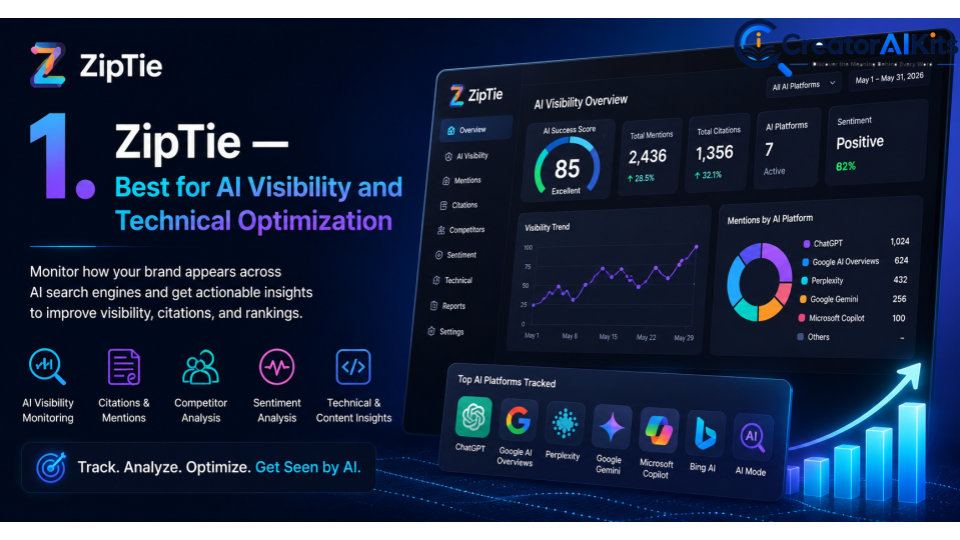
ZipTie is a strong choice for teams that want detailed AI-search visibility data and actionable optimization recommendations.
The platform tracks how brands appear across AI environments including ChatGPT, Google AI Overviews, Perplexity, Google AI Mode, Microsoft Copilot, Bing AI Overview, and Google Gemini. It can capture mentions, citations, sentiment, competitor recommendations, and full responses.
Its AI Success Score can help teams prioritize which prompts and visibility problems deserve attention first.
Key Features
- AI visibility monitoring
- Brand and competitor tracking
- Citation analysis
- Sentiment analysis
- AI Success Score
- Prompt monitoring
- Technical and content insights
- API and MCP access
- Optional AI-search content generation
Pricing
ZipTie uses usage-based pricing rather than a traditional per-seat model. Current preset starting points include approximately $35.63/month for Starter, with Professional and Enterprise options available at higher levels. It also offers a 7-day free trial with 25 daily prompts across ChatGPT, Google AI Overviews, and Perplexity.
Best For
Technical SEO teams, developers, agencies, and businesses that want detailed AI-search monitoring plus optimization guidance.
Limitation
The usage-based pricing model can become more expensive as you increase prompt volume and AI-engine coverage.
Frase — Best for Content and SEO Teams
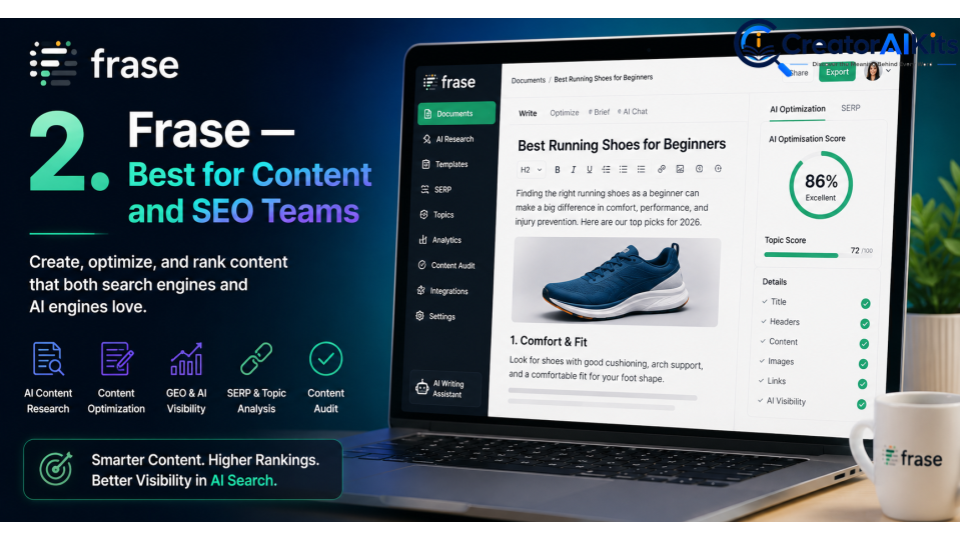
Frase is particularly useful when your main problem is creating and optimizing content that both search engines and AI systems can understand.
Its AI Visibility functionality allows teams to monitor brand visibility, while the broader platform includes content research, optimization, auditing, and publishing workflows.
For e-commerce, Frase can be useful for creating:
- Product guides
- Buying guides
- Category content
- Comparison pages
- FAQs
- Supporting informational content
Pricing
Frase’s current Starter plan is $39/month when billed annually or $49 month-to-month. Professional is $103/month annually, while Scale starts at $239/month annually. Enterprise pricing is customized.
Best For
Content writers, SEO specialists, marketing teams, and businesses that want content creation and AI visibility in one workflow.
Limitation
Frase is more content-focused than some specialized e-commerce platforms that track individual products and SKUs.
Dageno AI — Best for AI Visibility + GEO Execution
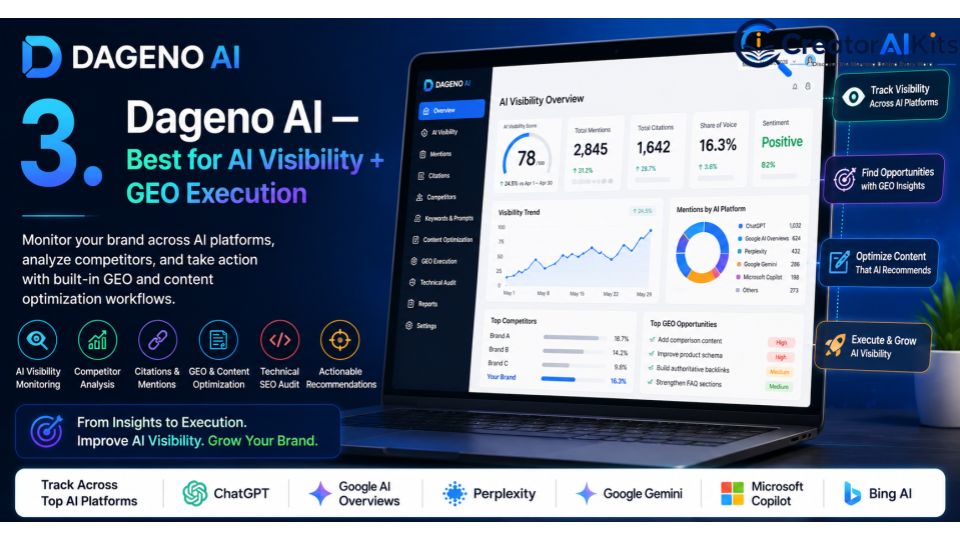
Dageno AI is designed to connect AI visibility monitoring with actual optimization work.
The platform can monitor prompts, brand mentions, competitors, citations, and AI platforms while also providing GEO and content-related workflows.
This makes it useful for teams that don’t want a dashboard that simply tells them:
“Your visibility is low.”
Instead, they want help understanding what should be improved next.
Key Features
- AI visibility monitoring
- Prompt tracking
- Competitor analysis
- Citation insights
- GEO audits
- Content optimization
- Technical SEO analysis
- Product-page optimization
- AI-search recommendations
Pricing
Dageno AI currently lists:
- Starter: $79/month
- Growth: $199/month
- Scale: $499/month
- Enterprise: Custom pricing
All plans include a 7-day free trial.
Best For
Growing e-commerce brands, SEO teams, content teams, and agencies that want monitoring and optimization together.
Siftly — Best for E-commerce AI Shopping Visibility
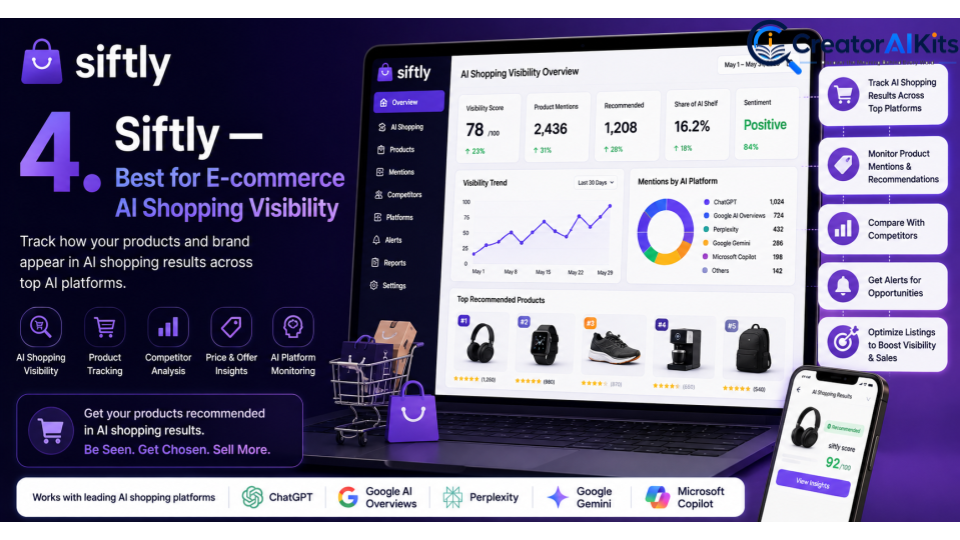
Siftly is especially relevant to e-commerce because it focuses on AI search and shopping visibility.
Rather than looking only at whether a company is mentioned, e-commerce teams can use Siftly to understand product and shopping-related visibility, competitors, citations, and content opportunities.
Key Features
- AI visibility tracking
- Product visibility analysis
- Competitor tracking
- AI shopping insights
- Citation analysis
- Content optimization
- GEO-focused content creation
- Outreach opportunities
Pricing
Siftly offers a free tier with 100 responses and 10 unique prompts per month. Its Starter plan is currently $79/month, while Growth starts at $249/month.
Best For
DTC brands, online stores, Shopify businesses, product marketers, and e-commerce teams focused on AI shopping visibility.
Limitation
Larger stores with very extensive catalogs may need a higher plan or enterprise arrangement.
Profound — Best for Enterprise E-commerce
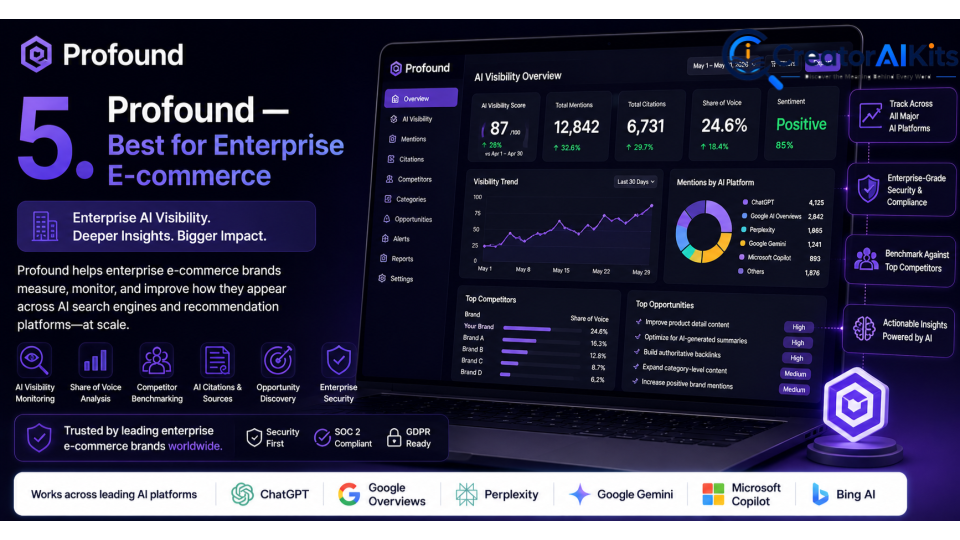
Profound is one of the stronger choices for larger organizations that need detailed AI-search analytics, reporting, competitive benchmarking, and enterprise workflows.
The platform tracks brand visibility, share of voice, sentiment, citations, and competitors across AI answer engines. Its platform also provides actionable recommendations through agents.
Profound is particularly interesting for large businesses because it can analyze large-scale AI-search data and provide reporting for marketing teams and leadership.
Pricing
Current self-serve pricing includes:
- Starter: $99/month billed annually
- Growth: $399/month billed annually
- Enterprise: Custom
The Growth plan supports three answer engines and 100 tracked prompts, while Enterprise provides broader engine coverage, multiple companies, customized tracking, SSO/SAML, and SOC 2-related enterprise capabilities.
Best For
Enterprise e-commerce brands, large marketing teams, agencies, and organizations that need deep AI visibility reporting.
Limitation
The pricing and capabilities can be excessive for a small online store.
Semrush AI Visibility Toolkit — Best for Existing SEO Users
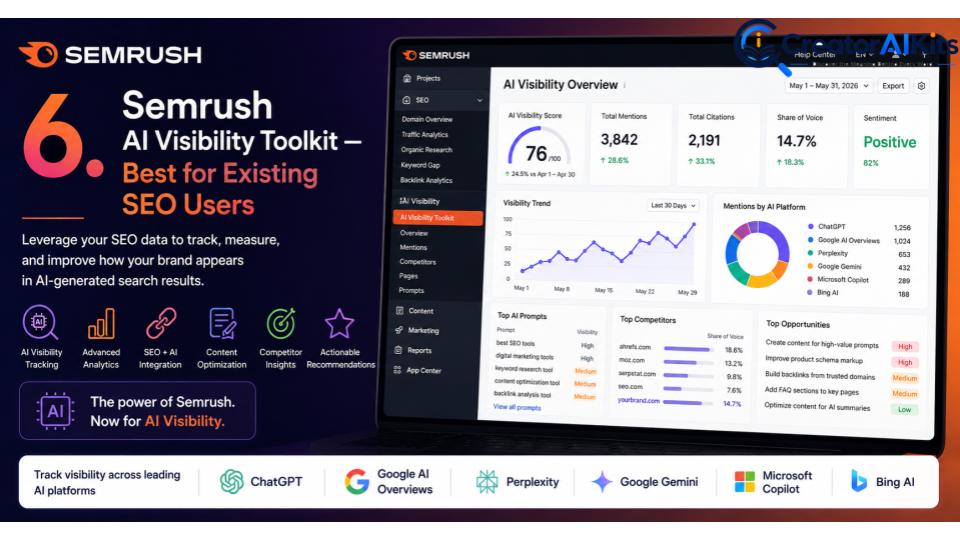
If your team already uses Semrush, its AI Visibility Toolkit is worth considering because it connects AI-search data with a broader SEO ecosystem.
The toolkit can monitor brand visibility, sentiment, competitors, citations, prompts, and AI search performance.
Pricing
The AI Visibility Toolkit currently starts at $99/month per domain.
It includes 25 custom prompts, AI visibility reports, competitor analysis, prompt research, and AI-readiness site auditing.
Best For
SEO professionals, agencies, and e-commerce businesses already using Semrush.
Limitation
If you only want AI visibility monitoring, a dedicated platform may offer a more specialized workflow.
Peec AI — Best for Agencies and Multi-Brand Tracking
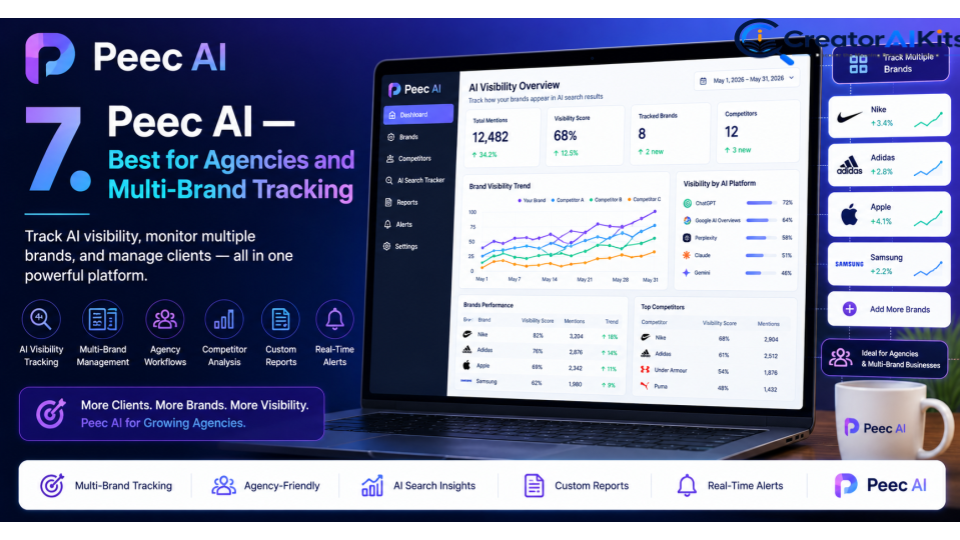
Peec AI is designed around AI-search analytics for marketing teams and agencies.
It allows users to monitor prompts, AI models, brand visibility, competitors, and performance across multiple projects.
Pricing
Current brand pricing includes:
- Starter: $95/month
- Pro: $245/month
- Advanced: $495/month
- Enterprise: Custom
The plans differ mainly in prompt volume, projects, models, and advanced reporting capabilities.
Best For
SEO agencies, marketing agencies, and businesses managing multiple brands or markets.
Limitation
Peec is primarily an analytics and visibility platform, so teams may still need other tools for technical implementation and content production.
OtterlyAI — Best Budget-Friendly Option
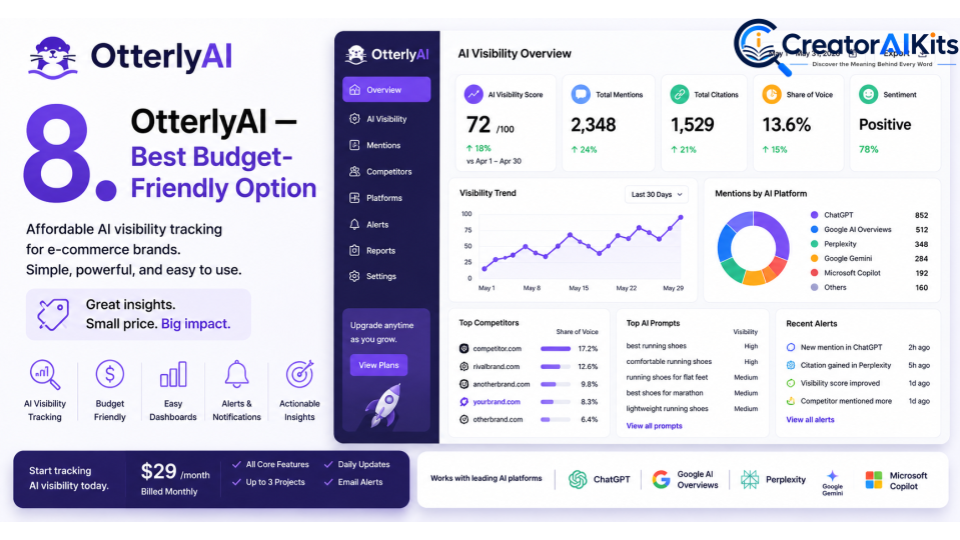
For small businesses that don’t want to spend hundreds of dollars every month, OtterlyAI is one of the more accessible options.
Its entry-level plan tracks ChatGPT, Google AI Overviews, Perplexity, and Microsoft Copilot.
Pricing
Current pricing:
- Lite: $29/month
- Standard: $189/month
- Premium: $489/month
- Enterprise: Custom
The Lite plan supports 15 prompts, while Standard supports 100 and Premium 400. Additional engines such as Gemini, Claude, and Google AI Mode are available as add-ons.
Best For
Solo marketers, small e-commerce businesses, and teams that primarily need AI visibility monitoring.
Limitation
Some important AI engines are additional paid add-ons, so calculate the total cost based on the platforms you actually need.
Surfer AI Search Analytics — Best for Content Optimization
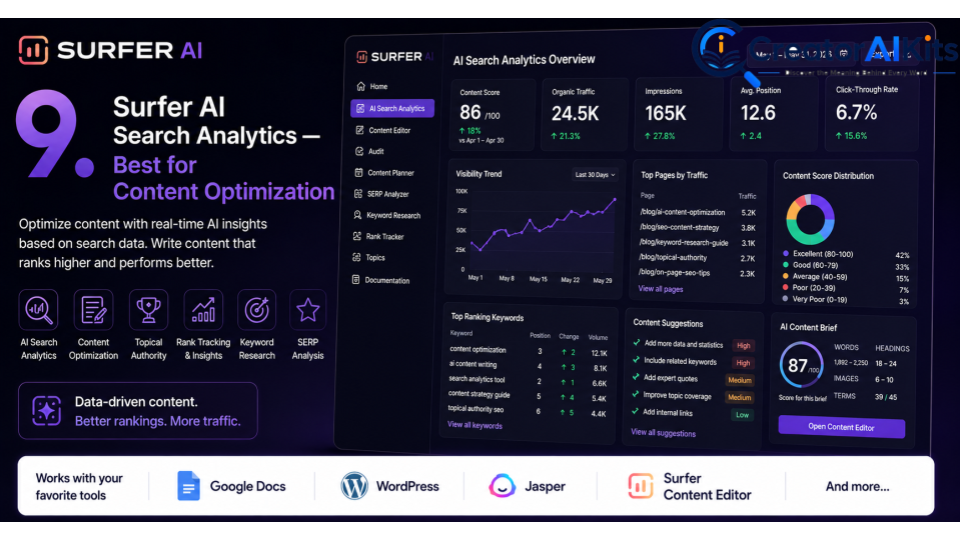
Surfer is well known for content optimization, and its AI Search Analytics extends that workflow into AI-search visibility.
This can be useful for content teams that want to understand how their brand performs in AI search while continuing to optimize website content.
Pricing
Current AI Search Analytics pricing depends on daily prompt volume:
- 50 prompts: $95/month
- 100 prompts: $185/month
- 200 prompts: $365/month
- Unlimited: Custom
Annual billing reduces the effective monthly cost.
Best For
Content teams, SEO writers, publishers, and e-commerce businesses that already use Surfer for content optimization.
Limitation
It may not provide the same product-level e-commerce depth as specialized shopping intelligence platforms.
10. Scrunch — Best for Growing and Enterprise Brands
Scrunch focuses on AI visibility, site audits, and understanding how AI systems interpret and represent a brand.
Its Core plan includes 125 unique prompts, five site audits per month, one brand workspace, and five user licenses.
Pricing
The current Core plan is $250/month, while Enterprise pricing is customized. The Core plan supports four AI platforms: ChatGPT, Perplexity, Google AI Overviews, and Microsoft Copilot.
Best For
Growing brands and larger teams that want AI visibility benchmarking and website audits.
Limitation
Its entry price is considerably higher than budget-focused platforms such as OtterlyAI.
Which AI Optimization Tool Should You Choose?
The best platform depends on your business size and your main objective.
For Technical & Development Teams
Choose ZipTie if your team needs detailed AI-search visibility data, competitor analysis, citations, and actionable recommendations.
It is particularly useful when SEO and development teams need to understand which pages and prompts are performing well and where optimization opportunities exist.
For Content & Copywriting Teams
Choose Frase or Dageno AI.
Frase is particularly useful for content research, writing, optimization, and GEO workflows. Dageno AI is broader, combining AI visibility monitoring with technical SEO, content, citation, competitor, and GEO workflows.
For E-commerce and Product Visibility
Choose Siftly or Profound.
These platforms are more appropriate when your concern goes beyond brand mentions and into product discovery, AI shopping, competitive visibility, and large-scale e-commerce intelligence.
For Enterprise E-commerce
Consider Profound, Semrush, or Scrunch depending on whether your priority is enterprise reporting, SEO integration, or AI visibility and site auditing.
For Small Businesses
Start with OtterlyAI, Siftly’s free plan, or a lower-volume ZipTie setup.
You do not need an expensive enterprise platform if you only have a small catalog and a handful of important customer prompts to monitor.
How We Selected These AI Optimization Tools
To make this list useful rather than simply creating another “top 10” list, the tools were evaluated around practical e-commerce requirements:
- AI visibility tracking — Can the platform measure brand presence in AI answers?
- Citation monitoring — Can you understand which sources AI systems reference?
- Competitor analysis — Can you see which competitors appear instead?
- E-commerce relevance — Does the platform help with products, shopping, or product content?
- Optimization capabilities — Does it help identify what to improve?
- Ease of use — Can an SEO or marketing team use it without extensive technical knowledge?
- Pricing transparency — Is there publicly available pricing or a clear entry point?
- Scalability — Can the platform grow with a larger website or team?
This approach is more useful than ranking tools solely by the number of features they advertise.
How to Improve E-commerce AI Visibility
Buying an AI visibility tool is only the first step. The tool will not automatically make your products appear in AI recommendations.
A practical optimization process looks like this:
1. Identify Real Buyer Prompts
Create prompts based on how your customers actually search.
For example:
- “Best wireless headphones under $100”
- “Best skincare products for dry skin”
- “Best running shoes for beginners”
- “Compare Brand A vs Brand B”
- “Where can I buy [product]?”
2. Track Your Visibility
Run these prompts regularly across relevant AI platforms and record:
- Your brand position
- Competitor mentions
- Product recommendations
- Citations
- Sentiment
- Missing information
3. Improve Product Pages
Make product information clear and complete.
Include:
- Accurate product names
- Detailed descriptions
- Specifications
- Sizes and variants
- Pricing information
- Availability
- Shipping information
- Returns information
- FAQs
- High-quality images
- Relevant structured data
4. Build Supporting Content
Don’t rely only on product pages.
Create useful:
- Buying guides
- Comparisons
- Product reviews
- How-to guides
- FAQs
- Category guides
This gives search engines and AI systems more useful information to understand your products.
5. Build Trust
E-E-A-T principles are especially important for product and commercial content.
Show:
- Who created the content
- Relevant expertise
- Original information
- Accurate product details
- Clear business information
- Customer reviews where appropriate
- Authoritative references
- Transparent pricing and policies
Do not invent reviews, expertise, statistics, or product claims simply to make content appear more authoritative.
6. Measure Again
After making changes, continue tracking the same prompts.
The objective is not simply to get a high score inside an AI optimization platform. The real objective is to improve visibility, qualified traffic, product discovery, and ultimately business results.
Frequently Asked Questions
What is AI optimization for e-commerce?
AI optimization is the process of improving a website, product information, and online presence so that AI-powered search and answer engines can understand, reference, and potentially recommend the brand or its products.
Is AI optimization replacing SEO?
No. AI optimization should complement traditional SEO.
Technical SEO, useful content, structured data, crawlability, internal linking, authority, and user experience remain important foundations.
Which AI optimization tool is best for e-commerce?
There is no single best tool for every store.
Siftly and Profound are strong options when product and shopping visibility are important. Frase and Dageno AI are useful for content and GEO workflows. ZipTie is strong for detailed AI visibility monitoring and optimization. OtterlyAI is a more affordable starting point.
How much do AI visibility tools cost?
Pricing ranges from free plans to several hundred dollars per month. For example, OtterlyAI starts at $29/month, Frase at $39/month, Dageno AI at $79/month, Profound at $99/month, and Scrunch at $250/month. Enterprise plans can cost considerably more.
Can AI optimization tools guarantee that my products will appear in ChatGPT or Gemini?
No.
No legitimate optimization platform can guarantee a specific AI recommendation. AI-generated results can change based on the query, location, model, sources, product availability, and other factors.
The goal is to improve the quality and accessibility of your information and measure whether visibility improves over time.
Final Verdict
AI search is becoming an important part of the e-commerce discovery journey in 2026. Customers can increasingly use AI platforms to research products, compare brands, and decide what to purchase before they ever visit a traditional search result.
That does not mean businesses should abandon SEO. Instead, e-commerce brands should build on their existing SEO strategy with AI visibility monitoring, high-quality product information, helpful content, structured data, authoritative references, and continuous measurement.
For technical and visibility-focused teams, ZipTie is a strong option. Content teams may prefer Frase or Dageno AI. E-commerce brands focused heavily on AI shopping should look closely at Siftly and Profound. Businesses already invested in SEO ecosystems may benefit from Semrush or Surfer, while smaller teams can start with OtterlyAI.
The most important point is simple: don’t optimize for an AI score just because a tool gives you one. Optimize for real customers.
Make your product information accurate, useful, accessible, trustworthy, and easy to understand. Then use AI visibility tools to measure whether those improvements are helping your brand get discovered where modern shoppers are asking questions.

Welcome to CreatorAIKits! I’m passionate about learning and exploring AI tools, creativity, and technology.
I’m continuously researching and gaining hands-on experience with different AI tools and technologies.
My goal is to share simple, useful, and practical AI information for beginners and everyday users.
Thanks for visiting CreatorAIKits!