
Creating more content does not automatically mean getting more organic traffic.
In 2026, AI can help businesses research topics, analyze search intent, build content briefs, draft articles, identify content gaps, repurpose existing content, and analyze performance. But there is a major difference between using AI to build a smarter content strategy and simply publishing large amounts of AI-generated content.
A successful AI content strategy combines artificial intelligence with human expertise, original insights, search-intent analysis, reliable research, and continuous optimization.
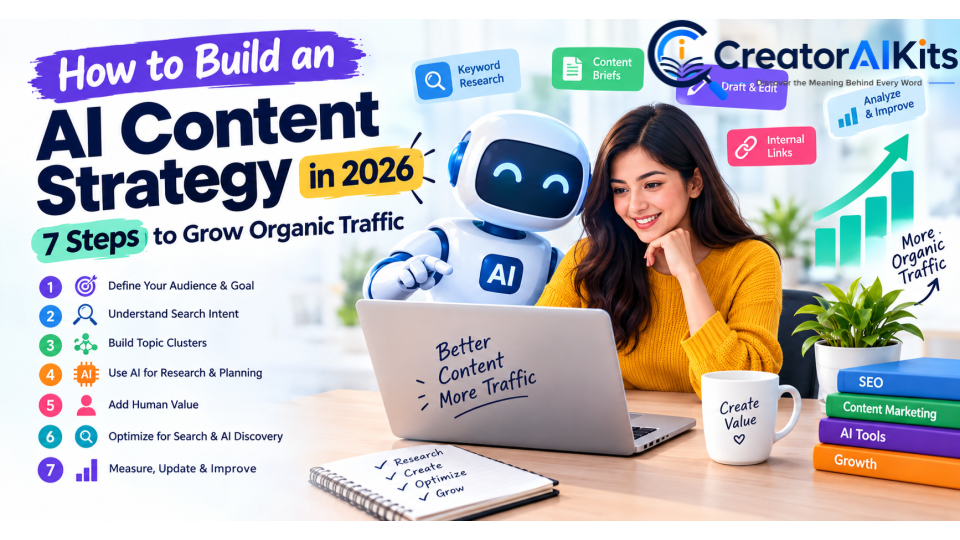
In this guide, you’ll learn how to build an AI content strategy in 2026 using seven practical steps—from defining your audience and identifying search intent to building topic clusters, using AI throughout the content workflow, optimizing for Google Search and AI-powered search experiences, and improving your strategy using real performance data.
Quick answer: A strong AI content strategy starts with a clear audience and business goal, maps search intent, builds connected topic clusters, uses AI to accelerate research and production, adds original human value, follows SEO fundamentals, and continuously improves content based on performance data.
What Is an AI Content Strategy?
An AI content strategy is a structured approach to using artificial intelligence to support content research, planning, creation, optimization, distribution, and analysis.
The important word is support.
AI should not simply be treated as a button that generates articles.
A well-designed workflow can use AI for:
- Topic research
- Search-intent analysis
- Content briefs
- Outline generation
- Competitor-gap analysis
- Question discovery
- Content repurposing
- Internal-link ideas
- Content audits
- Performance analysis
- Workflow automation
Humans should remain responsible for:
- Content strategy
- Original insights
- Fact-checking
- Important claims
- Brand voice
- First-hand experience
- Final editorial decisions
Google’s guidance emphasizes helpful, reliable, people-first content and says its systems aim to recognize qualities associated with experience, expertise, authoritativeness, and trustworthiness (E-E-A-T).
Google also says generative AI can be useful for research and adding structure to original content, but producing many pages without adding value can violate its scaled-content-abuse policy.
Why an AI Content Strategy Matters in 2026
The way people discover information is changing.
Traditional Google Search remains important, while Google’s search experience increasingly includes AI-powered features such as AI Overviews and AI Mode.
Google’s current documentation says the same foundational SEO practices remain relevant to these AI experiences. There is no separate trick or special markup that guarantees visibility in AI Search.
That makes a strong content strategy more important—not less.
Instead of thinking only:
Keyword → Article → Ranking
a modern strategy should consider:
Audience → Search intent → Topic → Original value → Useful content → Search visibility → Continuous improvement
Google’s guidance for generative AI search also emphasizes creating unique, valuable content rather than simply reproducing information that already exists elsewhere.
The 7-Step AI Content Strategy
| Step | What You Do | Main Goal |
| 1 | Define your audience and business goal | Know who you want to reach |
| 2 | Identify search intent and content opportunities | Understand what users need |
| 3 | Build topic clusters | Develop topical depth |
| 4 | Use AI for research and content planning | Improve efficiency |
| 5 | Add original human value | Make content genuinely useful |
| 6 | Optimize for Search and AI discovery | Improve visibility |
| 7 | Measure, update, and improve | Build sustainable growth |
Step 1: Define Your Audience and Business Goal

Before asking AI to generate dozens of article ideas, determine who you are trying to help.
A strong content strategy starts with the audience—not the AI tool.
Ask yourself:
Who is my target reader?
For example:
- Students
- Content creators
- Marketers
- Small businesses
- Recruiters
- Developers
- Entrepreneurs
- Beginners
What problem are they trying to solve?
For example:
“I want to create professional videos with AI but don’t know which tools to use.”
What outcome do they want?
For example:
“I want to create a complete video without appearing on camera.”
What should happen after they read your article?
Depending on your business, you may want readers to:
- Read another article
- Try a recommended tool
- Subscribe to your newsletter
- Download a resource
- Contact your business
- Explore a related service
This gives every piece of content a clear purpose.
Step 2: Identify Search Intent Before Creating Content
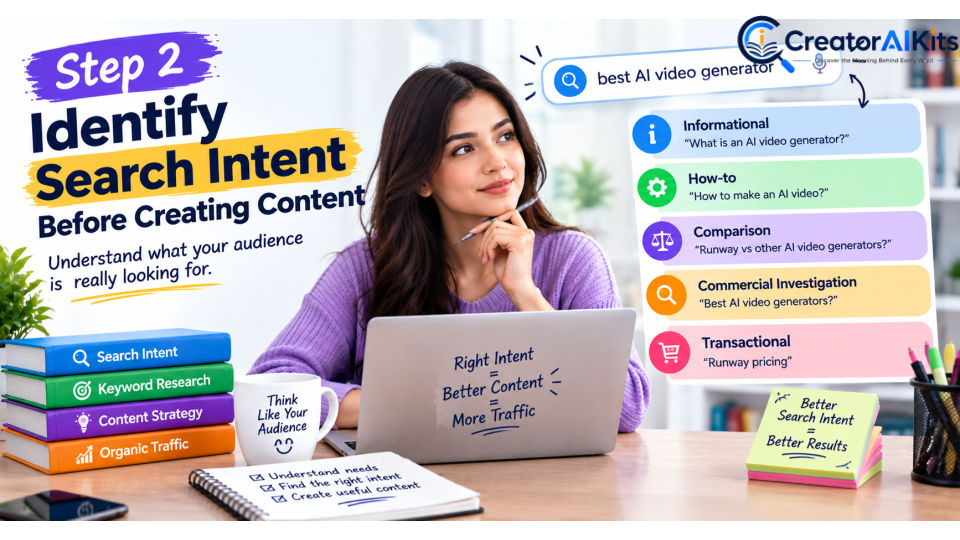
Search intent is the reason behind a user’s search.
Understanding it is essential because the same topic can require completely different content depending on what the searcher wants.
Informational intent
“What is an AI video generator?”
The user wants an explanation.
How-to intent
“How to make an AI video”
The user wants instructions.
Comparison intent
“Runway vs other AI video generators”
The user wants to compare options.
Commercial investigation
“Best AI video generators”
The user is researching potential solutions.
Transactional intent
“Runway pricing”
The user is looking for pricing or preparing to take an action.
A strong AI content strategy should cover the search journey instead of producing only generic informational articles.
Step 3: Build Topic Clusters Instead of Random Articles
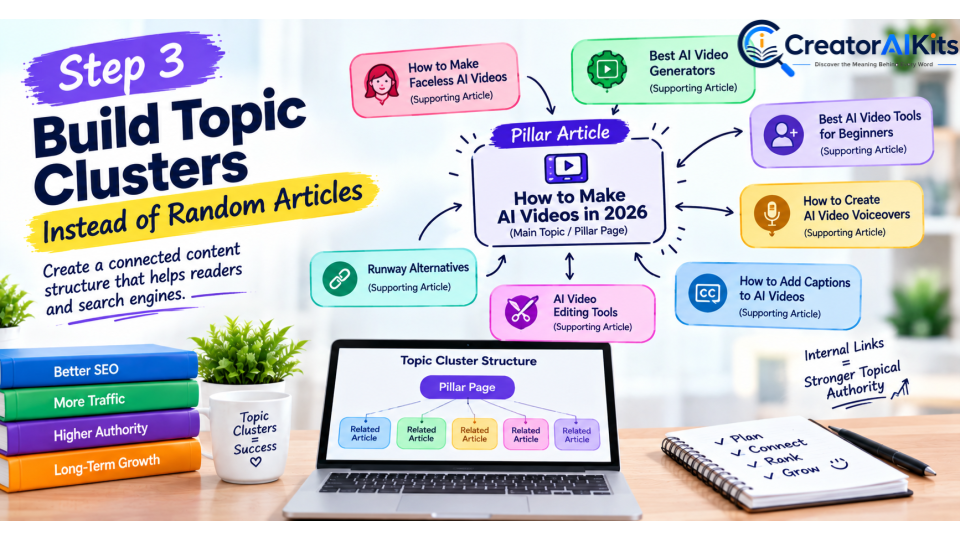
One of the most effective ways to organize an expanding content library is to create topic clusters.
Instead of publishing unrelated articles:
Article A → Article B → Article C
build a connected structure.
For example, suppose your main topic is AI video creation.
Pillar article
How to Make AI Videos in 2026
Supporting articles could include:
- How to Make Faceless AI Videos
- Best AI Video Generators
- Best AI Video Tools for Beginners
- How to Create AI Video Voiceovers
- How to Add Captions to AI Videos
- AI Video Editing Tools
- Runway Alternatives
Then connect relevant articles using internal links.
This gives readers a logical path through related information and helps search engines discover related pages. Google’s Search Essentials also recommends making links crawlable so Search can discover other pages on your website.
Current SEO strategy research also commonly recommends combining pillar pages with related cluster content rather than treating every article as an isolated page.
Step 4: Use AI for Research and Content Planning
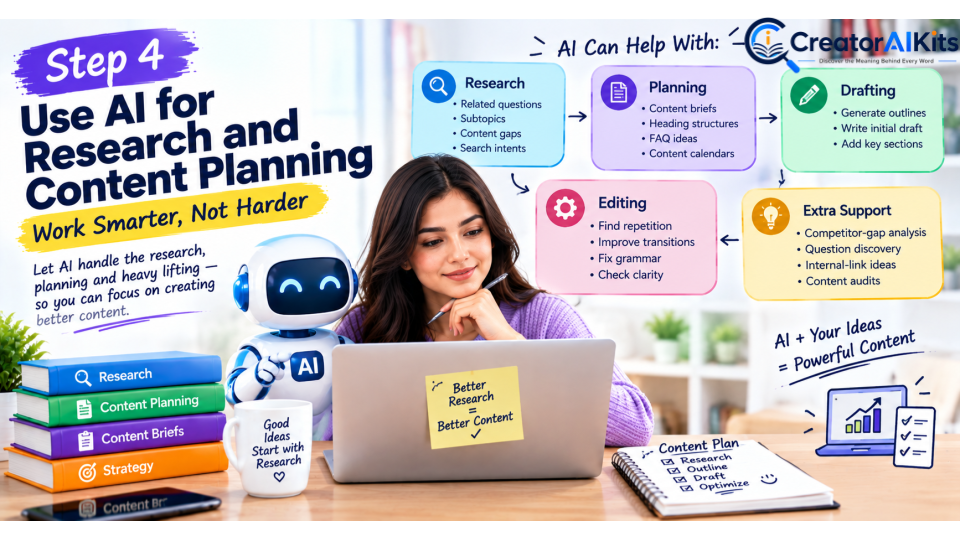
AI can significantly speed up the content workflow when it is used for the right tasks.
Instead of asking:
“Write me a 2,000-word article.”
use AI throughout the process.
Research
AI can help you explore:
- Related questions
- Subtopics
- Potential content gaps
- Different search intents
- Possible article structures
Planning
AI can assist with:
- Content briefs
- Heading structures
- FAQ ideas
- Comparison criteria
- Internal-link opportunities
- Content calendars
Drafting
AI can help create an initial draft or individual sections.
Editing
AI can help identify:
- Repetition
- Weak transitions
- Unclear sentences
- Missing explanations
- Grammar problems
But AI output should still be reviewed, fact-checked, and improved before publication.
Google explicitly says generative AI can be useful for research and structure, while warning against using it to generate many pages without adding value.
Step 5: Add Original Human Value
This is where an AI-assisted article can become significantly more useful than a generic AI-generated page.
Ask:
“What does this article provide that a reader cannot get from a dozen generic summaries?”
You can add value through:
First-hand testing
If you actually tested a tool, explain:
- What you tested
- How you tested it
- What worked
- What did not
- Who should use it
Original screenshots
Show the actual workflow or interface.
Real examples
Instead of writing:
“This AI tool is useful for creators.”
show exactly how a creator can use it.
Practical comparisons
Compare tools using meaningful criteria rather than repeating marketing claims.
Limitations
Tell readers where a tool may not be suitable.
Your own workflow
Explain how you actually approach a task.
Google’s guidance highlights first-hand experience as an important aspect of demonstrating E-E-A-T where it is relevant.
Important: never claim that you tested a product or tool if you did not actually test it.
Step 6: Optimize for Google Search and AI Search
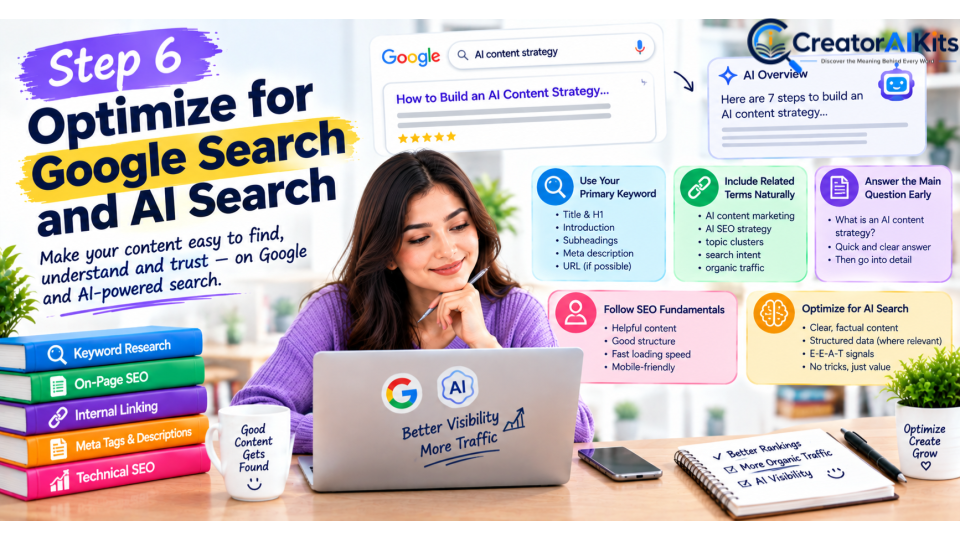
SEO remains important in 2026.
However, optimization should focus on helping search engines understand useful content, not stuffing keywords into every paragraph.
Google’s official guidance says its foundational SEO practices continue to apply to AI-powered Search experiences.
Use your primary keyword naturally
For this article, the primary keyword is:
AI content strategy
It can naturally appear in:
- Title
- H1
- Introduction
- Relevant subheadings
- Body content
- Meta description
- URL, if appropriate
Use related terms naturally
For example:
- AI content marketing
- AI SEO strategy
- AI content workflow
- AI content planning
- AI-assisted content
- organic traffic
- topic clusters
- search intent
Do not force these phrases into every section.
Answer the main question early
For example:
What is an AI content strategy?
Answer it immediately before providing deeper explanations.
This improves usability because readers don’t have to search through hundreds of words to find the basic answer.
Step 7: Measure, Update, and Improve Your Content
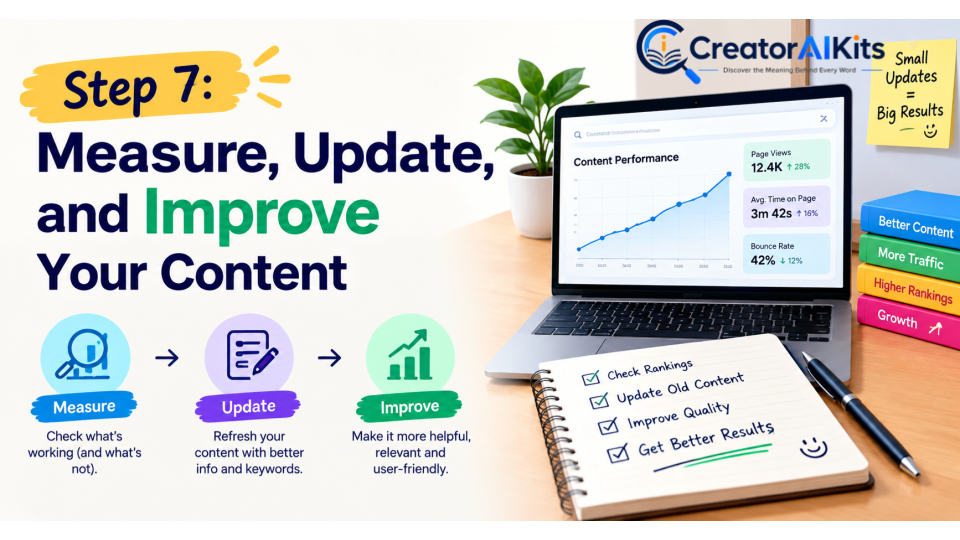
Publishing an article is not the end of your content strategy.
It is the beginning of the optimization cycle.
Track metrics such as:
- Impressions
- Clicks
- Click-through rate
- Average position
- Organic traffic
- Indexed pages
- Top-performing topics
- Pages losing traffic
- Internal-link opportunities
- Conversions
Use the data to make decisions
High impressions + low CTR
→ Review the title and meta description.
Impressions + some clicks + weak rankings
→ Examine search intent, content depth, originality, internal links, and competing pages.
Good rankings + weak engagement
→ Check whether the page actually satisfies the visitor.
Strong traffic + strong conversions
→ Build related content around that topic.
Google Search Console can help website owners understand Search performance, while Google’s current AI Search documentation explains how traditional SEO fundamentals continue to matter for AI-powered search experiences.
The AI Content Workflow I Recommend
A practical workflow looks like this:
1. Research the topic
↓
2. Identify search intent
↓
3. Build the content brief
↓
4. Verify important information with reliable sources
↓
5. Use AI for structured assistance
↓
6. Add original insights, examples, and evidence
↓
7. Fact-check the final draft
↓
8. Optimize the page for search and usability
↓
9. Publish
↓
10. Measure performance
↓
11. Update when there is a genuine reason to improve it
This is considerably stronger than:
Keyword → AI → Publish
AI Content Strategy vs. Traditional Content Strategy
| Area | Traditional Approach | AI-Assisted Approach |
| Topic research | Mostly manual | Human + AI assistance |
| Content ideas | Manual research | AI-assisted discovery |
| Outlines | Manual | AI-assisted |
| Drafting | Mostly human | Human + AI |
| Fact-checking | Human | Human |
| Original insights | Human | Human |
| Repurposing | Mostly manual | AI-assisted |
| Performance analysis | Manual | AI-assisted + human interpretation |
| Final publishing decision | Human | Human |
The objective is not to replace the strategist.
The objective is to give the strategist better tools and a more efficient workflow.
How to Turn One Article Into Multiple Content Assets
A strong content strategy does not have to start from zero every time you create something new.
One genuinely useful article can become:
Original article
↓
YouTube video
↓
Short-form video
↓
LinkedIn post
↓
Social-media carousel
↓
Email newsletter
↓
FAQ content
↓
Infographic
The important point is that each format should be adapted to its audience rather than mechanically copying the same content everywhere.
A Practical Example of an AI Content Strategy
Imagine your website focuses on AI tools.
Instead of publishing unrelated articles such as:
- Best AI Tool X
- Best AI Tool Y
- What Is AI?
- 10 AI Tools
you could build organized topic clusters.
Main AI Content Pillars
AI Writing
- Best AI Writing Tools
- How to Use AI for Blog Writing
- AI Writing vs. Human Writing
AI Video
- Best AI Video Generators
- How to Make Faceless AI Videos
- AI Video Editing Guide
AI Images
- Best AI Image Generators
- Best AI Thumbnail Tools
- How to Create AI Images
AI Productivity
- Best AI Productivity Tools
- Best AI Research Tools
- AI Meeting Assistants
Each supporting article can link naturally to other relevant pages.
This creates a more organized content ecosystem instead of a collection of disconnected posts.
5 AI Content Strategy Mistakes to Avoid
1. Publishing as Much as Possible
More articles do not automatically produce more traffic.
Google’s guidance emphasizes people-first content and warns against creating content primarily to attract search-engine traffic.
2. Publishing Generic AI Content
If an article simply repeats information already available on many websites, it may provide little additional value.
3. Ignoring Search Intent
A well-written article can still underperform if it does not satisfy what the searcher actually wants.
4. Creating Disconnected Content
Publishing articles without a logical relationship can make it harder to build a coherent topical structure.
5. Never Improving Existing Articles
Content strategy should include maintenance.
When information, products, features, or recommendations change, review the relevant page and update it when there is a genuine reason.
Do not simply change the publication date to make old content appear fresh. Google’s guidance specifically warns against doing this without substantial content changes.
How to Build Trust With AI-Assisted Content
Before publishing an AI-assisted article, ask:
Is it accurate?
Have important factual claims been verified?
Is it original?
Does it provide something beyond a generic summary?
Does it demonstrate experience?
Where appropriate, have you included genuine testing, screenshots, examples, or observations?
Is it transparent?
Would readers understand how the information was produced when that context is relevant?
Is it useful?
Does the article actually solve the reader’s problem?
Is it written for people?
Would you still publish it if search engines did not exist?
That last question is particularly useful.
If the answer is no, the content strategy probably needs improvement.
Frequently Asked Questions
What is an AI content strategy?
An AI content strategy is a structured approach to using artificial intelligence for content research, planning, creation, optimization, distribution, and analysis while maintaining human oversight over strategy, accuracy, and quality.
Can AI-generated content rank on Google?
AI-assisted or AI-generated content can appear in Google Search. Google says its systems focus on the quality and value of content rather than simply how the content was produced. However, using AI to generate large amounts of low-value content without adding user value can violate Google’s spam policies.
Is AI content good for SEO?
AI can be useful for SEO research, planning, outlining, analysis, and other workflow tasks. But AI alone is not an SEO strategy. Content still needs to satisfy search intent, provide value, be accurate, and follow Google’s Search Essentials.
How often should I publish AI-assisted content?
There is no universal publishing frequency that guarantees rankings. A sustainable publishing schedule is better than producing large quantities of content that cannot be properly researched, edited, and maintained.
Should AI write the entire article?
AI can help with drafting, but a stronger workflow combines AI assistance with human research, fact-checking, original insights, editing, and final review.
How can AI help increase organic traffic?
AI can help with topic discovery, research, content planning, workflow automation, content analysis, and identifying opportunities. However, traffic depends on the quality and relevance of the resulting content and how well it satisfies users.
Does AI content need human review?
For high-quality publishing, human review is strongly recommended—especially for important factual claims, product information, current statistics, recommendations, and first-hand experience claims.
Final Takeaway
A successful AI content strategy in 2026 is not about publishing the largest number of AI-generated articles.
It is about building a repeatable system that combines:
Human strategy + AI efficiency + reliable research + original value + SEO fundamentals + continuous improvement.
The seven-step process is:
1. Define your audience and goal
2. Identify search intent
3. Build topic clusters
4. Use AI for research and planning
5. Add original human value
6. Optimize for Search and AI discovery
7. Measure, update, and improve
AI can make content production faster.
But useful content still requires judgment.
The websites that build sustainable organic visibility will not necessarily be the ones publishing the most content. They will be the ones consistently creating content that answers real questions, provides meaningful value, demonstrates appropriate expertise and experience, and gives readers a reason to trust the information.
That is the foundation of a durable AI content strategy.
Research Sources
This article was reviewed against current Google Search documentation and 2026 SEO/content-strategy resources.
Key Google sources include:
- Google Search Central — Creating Helpful, Reliable, People-First Content
- Google Search Central — Guidance on Generative AI Content
- Google Search Central — Google’s Guide to AI Search / Generative AI Features
- Google Search Essentials
- Google Search Central — Guidance on AI-Generated Content

Welcome to CreatorAIKits! I’m passionate about learning and exploring AI tools, creativity, and technology.
I’m continuously researching and gaining hands-on experience with different AI tools and technologies.
My goal is to share simple, useful, and practical AI information for beginners and everyday users.
Thanks for visiting CreatorAIKits!