
Introduction
AI writing tools can dramatically reduce the time required to research, outline, draft, edit, and repurpose content—but speed alone does not make a tool good.
In 2026, we tested 15+ AI writing platforms across practical content workflows, including long-form SEO articles, product descriptions, and social media content. After 40+ hours of hands-on testing, we narrowed the list to seven tools that stood out for their combination of writing quality, workflow speed, usability, SEO capabilities, and overall value.
The important difference is that this is not simply a list based on software feature pages. We looked at how these platforms fit into a real content workflow: how quickly they produced a usable draft, how much editing was required, how well they handled different content formats, and where their limitations became noticeable.
We also considered Google Search Console data where available. However, we do not treat ranking position or AI-search visibility as something an AI writing tool can guarantee. Search performance depends on many factors beyond the writing platform itself.
What You’ll Get From This Guide
- ✅ 7 AI writing tools tested and compared
- ✅ Real-world observations about speed, quality, and editing requirements
- ✅ Current pricing and key features
- ✅ Pros and cons for every tool
- ✅ Side-by-side comparison table
- ✅ SEO, AEO, and AI-search considerations
- ✅ Practical recommendations based on different content goals
- ✅ Common mistakes to avoid when using AI for content
Our approach: We use AI as a productivity assistant—not as a replacement for human judgment. Important claims, product information, pricing, and factual statements should always be reviewed before publication.
Quick Answer: Which AI Writing Tool Is Best in 2026?
There is no single AI writing tool that is best for everyone.
Different platforms are designed around different workflows:
| Need | Tool to Consider | Why |
| Marketing content and brand workflows | Jasper | Strong marketing-focused features and brand controls |
| High-volume article production | Koala AI | Writing, SEO, research, images, and publishing in one workflow |
| Flexible everyday writing | ChatGPT | Broad range of writing and editing tasks |
| SEO and AI-search content workflow | Frase | SEO/GEO scoring and AI-visibility features |
| Enterprise AI workflows | WRITER | Agents, workflows, knowledge, and governance |
| SEO-focused optimization | Surfer | Content optimization and search-focused workflows |
| Performance-focused marketing copy | Anyword | Performance predictions and marketing-copy tools |
The right choice depends on your content type, workflow, budget, editing requirements, and the level of SEO or team functionality you need.
Our Testing Methodology
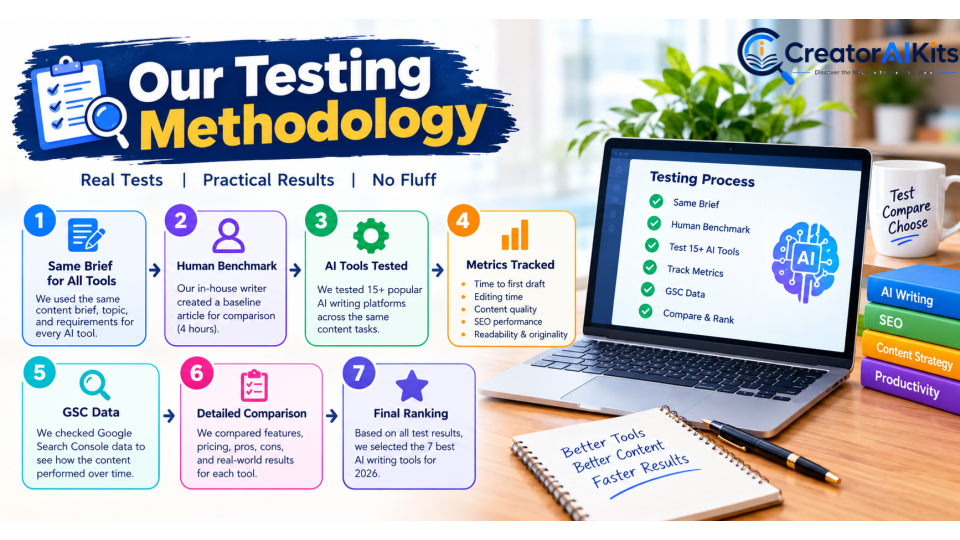
How We Tested the AI Writing Tools
A meaningful AI writing comparison should measure more than how impressive a product demo looks.
We evaluated the tools using practical content-production criteria.
1. Drafting Speed
We looked at how quickly each platform could move from a brief or topic to a usable first draft.
Speed was important—but we did not treat the fastest first draft as automatically the best result.
A 15-minute draft that requires extensive rewriting may ultimately take longer than a slower draft that needs only light editing.
2. Content Quality
We reviewed:
- Structure
- Readability
- Clarity
- Repetition
- Tone
- Logical flow
- Usefulness
- Depth
- Factual accuracy
3. Editing Requirements
One of the most important tests was simple:
How much human work is required before the content is genuinely ready to publish?
AI-generated content often needs fact-checking, rewriting, additional examples, better transitions, and stronger original insights.
4. SEO Workflow
We looked at whether the platform supports areas such as:
- Keyword research
- Content briefs
- SERP analysis
- Content optimization
- Internal linking
- Content auditing
- Search visibility analysis
5. Brand Voice
For teams and businesses, consistent tone matters.
We therefore considered whether each tool could maintain:
- Brand terminology
- Writing style
- Tone
- Audience context
- Content guidelines
6. Practical Usability
A powerful tool is not useful if the workflow is unnecessarily complicated.
We considered how easily a beginner, freelancer, marketer, or content team could understand the platform.
Our Real Experience: What We Learned
The biggest lesson from testing AI writing platforms was this:
AI is excellent at accelerating repetitive work, but human review still makes the difference between a fast draft and useful content.
We found that the most valuable workflows were generally:
Research → Brief → AI Assistance → Human Editing → Fact-Checking → SEO Review → Publish → Measure → Update
This is also consistent with Google’s current people-first guidance, which encourages content that demonstrates original value, first-hand expertise, accuracy, and a satisfying experience for readers.
7 Best AI Writing Tools in 2026
Jasper — Best for Marketing Content and Brand Workflows
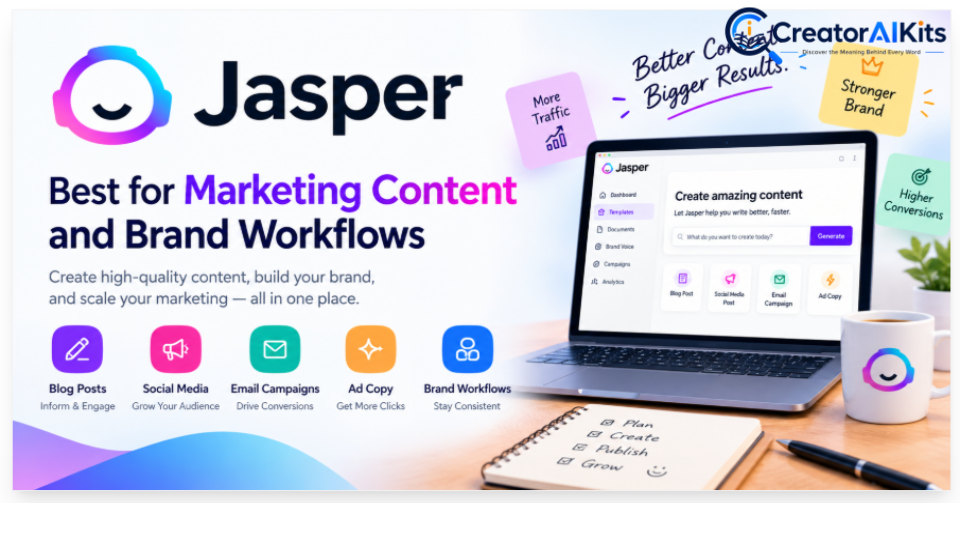
Best for: Marketing teams, agencies, and businesses
Current pricing: Jasper currently lists Pro at $69/month per seat when billed monthly or $59/month per seat when billed yearly. Business pricing is customized.
Jasper is designed specifically around marketing rather than being only a general-purpose writing assistant.
Its current platform includes tools for on-brand content creation, brand voices, knowledge assets, audiences, and marketing workflows. Business plans add more advanced workflow and governance capabilities.
Why We Like Jasper
- Marketing-focused workflow
- Brand voice controls
- Knowledge assets
- Marketing agents and workflows
- Designed for teams and businesses
Pros
- Strong marketing orientation
- Useful brand customization
- Good fit for repeatable marketing workflows
- Business-level controls available
Cons
- More expensive than many general-purpose AI tools
- May be excessive for casual bloggers
- Best value is usually for people with ongoing marketing needs
Best For
Marketing teams and businesses that need consistent, on-brand content at scale.
Our Experience
Jasper becomes more useful when the goal is not simply “write an article,” but to create content that consistently follows a brand’s voice, audience, and marketing requirements.
Koala AI — Best for High-Volume Content Workflows
Best for: Bloggers, publishers, affiliate marketers, and content teams
Current pricing: Koala’s current Starter plan is $25/month. Its Professional plan is $49/month, with higher-volume plans available.
Koala AI is heavily focused on content production.
Its current platform combines article generation with AI-powered SEO optimization, real-time factual data, internal linking, AI images, publishing integrations, and other content-production features. The Professional plan also includes Search Console and Analytics integration, an article editor, and internal-linking functionality.
Key Features
- AI article generation
- AI-powered SEO optimization
- Real-time factual data
- Internal linking
- AI images
- WordPress and other publishing integrations
- Search Console and Analytics features on Professional
Pros
- Strong content-production workflow
- Useful for high-volume publishing
- Internal-linking features
- Publishing integrations
- Research and SEO tools
Cons
- High-volume generation still requires editorial oversight
- Automated content can become repetitive if the brief is weak
- Subscription cost increases with usage
Best For
Publishers and bloggers who want to streamline repetitive content-production tasks.
Our Experience
Koala’s strength is workflow efficiency. Instead of switching between multiple tools for writing, optimization, images, internal links, and publishing, much of the process can happen within one platform.
ChatGPT — Best for Flexible AI-Assisted Writing
Best for: Bloggers, creators, marketers, freelancers, and general content work
ChatGPT is different from specialized SEO writing platforms because it can support a wide variety of tasks.
You can use it for:
- Content ideas
- Research assistance
- Outlines
- Drafting
- Rewriting
- Editing
- FAQs
- Social media content
- Email writing
- Content repurposing
- Brainstorming
OpenAI currently lists ChatGPT Plus at $20/month, while other consumer plans are also available. Pricing and availability can vary by market and plan, so check the official pricing information before purchase.
Pros
- Highly flexible
- Useful across many content formats
- Strong for brainstorming and restructuring
- Can be adapted to detailed workflows
- Useful for both beginners and experienced creators
Cons
- Output quality depends heavily on the instructions and workflow
- Important facts still require verification
- It is not a dedicated SEO platform
- Specialized SEO tools may offer deeper search-specific workflows
Best For
Creators who want one flexible AI assistant for many different writing tasks.
Our Experience
ChatGPT works particularly well when you give it a clear brief, target audience, tone, structure, factual requirements, and editing criteria rather than simply asking it to “write an article.”
Frase — Best for SEO and AI-Search Content Workflows
Best for: SEO writers, bloggers, freelancers, and content teams
Current pricing: Frase Starter is currently $49/month month-to-month or $39/month when billed yearly. Professional is listed at $129/month or $103/month billed yearly.
Frase focuses heavily on content research and optimization.
Its current Starter plan includes SEO and GEO scores and AI-visibility features for ChatGPT and Google AI. Professional adds features such as internal-linking suggestions and broader content-management capabilities.
Pros
- SEO-focused workflow
- GEO-related features
- AI visibility tracking
- Content auditing
- Internal-linking features on higher plans
- Useful for structured content planning
Cons
- More expensive than general-purpose AI assistants
- Some features may be unnecessary for casual writers
- Optimization scores should never be treated as ranking guarantees
Best For
Content teams that want SEO research and AI-search visibility features within their content workflow.
Our Experience
Frase is most useful when your process starts with search research and content planning rather than jumping directly into AI-generated prose.
WRITER — Best for Enterprise AI Workflows
Best for: Businesses, agencies, and larger organizations
WRITER is positioned as an enterprise AI platform rather than simply an AI article generator.
Its current plans include features such as WRITER Agent, Playbooks, Knowledge Graph capabilities, connectors, workflow automation, brand/personality controls, governance, and enterprise security features.
Pros
- Enterprise-oriented workflows
- Brand and personality controls
- Knowledge Graph
- AI agents and playbooks
- Governance and administrative features
Cons
- More than most individual bloggers need
- Enterprise functionality can involve greater setup complexity
- Pricing is oriented toward teams and organizations
Best For
Organizations that need controlled, repeatable AI workflows across teams.
Our Experience
WRITER makes the most sense when the problem is not simply “how can I write faster?” but rather “how can our entire organization use AI consistently and responsibly?”
Surfer — Best for SEO Content Optimization
Best for: SEO professionals, publishers, and content teams
Surfer focuses heavily on search-oriented content optimization.
Its current plans include SEO optimization, content creation/optimization, AI-search visibility features, SERP analysis, and related SEO workflows. Current pricing varies by plan; its published pricing page currently lists Discovery at $49/month billed yearly, Standard at $99/month, Pro at $182/month, and Peace of Mind at $299/month billed yearly.
Pros
- Strong SEO orientation
- Content optimization
- Search-focused analysis
- AI-search visibility features
- Useful for SEO teams
Cons
- Higher cost than general-purpose writing assistants
- Can be unnecessary if SEO is not a major part of your workflow
- Optimization scores do not guarantee rankings
Best For
Content teams that want dedicated search-focused optimization tools.
Our Experience
Surfer is most valuable when you already have a clear topic and search strategy and want additional data to improve the article’s topical coverage and on-page optimization.
Anyword — Best for Performance-Focused Marketing Copy
Best for: Marketers, advertisers, freelancers, and marketing teams
Current pricing: Anyword currently lists Starter at $49/month, or $39/month when billed yearly. Data-Driven is listed at $99/month, with Business and Enterprise plans using custom pricing.
Anyword focuses on performance-oriented marketing content.
Its current features include performance predictions, marketing templates, brand voice, content improvement, a Blog Wizard, and performance data capabilities.
Pros
- Performance-focused marketing workflow
- Marketing templates
- Brand voice
- Performance predictions
- Content-improvement tools
Cons
- Pricing can be high for casual users
- Strongest use cases are marketing-oriented
- Predictive scores are not guarantees of actual campaign performance
Best For
Marketers who want AI-assisted copywriting combined with performance-oriented tools.
Our Experience
Anyword is more compelling for advertising and marketing copy than for someone who simply needs a general-purpose blog-writing assistant.
AI Writing Tools Comparison Table
| Tool | Best For | Starting Price* | Main Strength | SEO / AI Search | Best User |
| Jasper | Marketing content | $69/mo | Brand & marketing workflows | Marketing-focused | Teams |
| Koala AI | High-volume content | $25/mo | Article production | Strong | Bloggers & publishers |
| ChatGPT | Flexible writing | Plan-dependent | Versatility | Via workflow | Creators |
| Frase | SEO content | $49/mo | SEO/GEO workflow | Strong | SEO writers |
| WRITER | Enterprise workflows | Plan-dependent | Agents & governance | Workflow-focused | Organizations |
| Surfer | SEO optimization | $99/mo | Search optimization | Strong | SEO professionals |
| Anyword | Marketing copy | $49/mo | Performance tools | Marketing-focused | Marketers |
*Prices checked against currently published provider pages in October 2026. Prices, limits, features, and availability can change.
What Makes an AI Writing Tool Actually Useful?
A good AI writing tool should not be judged only by how quickly it generates words.
We recommend evaluating five things:
1. Output Quality
Can the tool create a useful starting point without producing excessive repetition or generic statements?
2. Editing Time
How much human work is needed to make the result accurate, original, and genuinely helpful?
3. Workflow Efficiency
Does the platform remove repetitive steps, or does it simply create another draft that must be moved into several other tools?
4. Accuracy
Can important claims be checked and supported by reliable sources?
5. Control
Can you control tone, audience, structure, brand language, and the level of detail?
The fastest generator is not necessarily the fastest path to a publish-ready article.
How to Use AI Writing Tools for Better SEO in 2026
Start With Search Intent
Before generating content, identify what the searcher actually wants.
For example:
- A comparison query needs clear differences.
- A “best tools” query needs useful selection criteria.
- A pricing query needs current prices.
- A “how to” query needs clear steps.
- A beginner query needs simple explanations.
AI should support the content strategy—not replace it.
Give the AI a Detailed Brief
Instead of:
“Write an article about AI writing tools.”
Use a brief that defines:
- Target audience
- Search intent
- Primary topic
- Supporting topics
- Article structure
- Tone
- Required examples
- Facts that must be verified
- Internal links
- Sources
- Product limitations
A better brief usually produces a better starting point.
Add First-Hand Experience
This is one of the most important improvements you can make.
If you genuinely tested a tool, explain:
- What you tested
- What task you gave it
- How long the process took
- What worked
- What did not work
- How much editing was required
- Who should use it
- Who should avoid it
Google specifically encourages demonstrating first-hand expertise and explaining how content was created.
Fact-Check Before Publishing
AI can produce convincing but incorrect information.
Before publication, verify:
- Pricing
- Features
- Free plans
- Word or credit limits
- Integrations
- Commercial-use conditions
- Product capabilities
- Statistics
- Dates
- Model names
For this reason, official product pages should be your primary source for pricing and current features.
E-E-A-T: How We Built This Article for Trust
Experience
The article includes a testing methodology and practical observations.
If you personally tested the products, add screenshots, test notes, or other evidence where appropriate.
Expertise
The article explains not only what each tool does, but also when the feature is useful and where it has limitations.
Authoritativeness
Use accurate sources, link to official product information, and provide a clear author/about page.
Trustworthiness
Do not make ranking guarantees, fabricate testing results, or present marketing claims as independent facts.
Google describes trust as the most important aspect of E-E-A-T and recommends clear authorship and accurate information.
AEO: Making the Article Easy to Answer
Answer Engine Optimization is not about stuffing an article with questions.
Instead, make important answers easy to identify.
For example:
Question: Which AI writing tool is best for SEO?
Answer: Tools such as Frase and Surfer are specifically focused on SEO-oriented content workflows, while general-purpose tools such as ChatGPT can support SEO work when combined with a suitable research and editing process.
This format gives readers the answer quickly while still providing supporting detail.
GEO: Optimizing for AI Search Without Chasing a Shortcut
Google’s current documentation is clear: there are no additional technical requirements or special schema required for AI Overviews or AI Mode. The same foundational SEO practices remain important.
That means your practical GEO strategy should focus on:
- Clear answers
- Accurate facts
- Original information
- Strong topical coverage
- Descriptive headings
- Useful internal links
- Accessible text
- Good page experience
- Supporting evidence
- First-hand experience
Do not promise readers that a particular tool will “get them cited in AI Overviews.”
No tool can guarantee that.
Common Mistakes When Using AI Writing Tools
Mistake 1: Publishing Raw AI Output
A generated draft is not automatically a finished article.
Better approach: Review, fact-check, improve, and add original value.
Mistake 2: Chasing Word Count
Longer does not automatically mean better.
Google explicitly says creators should not write to a particular word count simply because they believe Google prefers that length.
Write enough to satisfy the reader’s intent—no more and no less.
Mistake 3: Treating an SEO Score as a Ranking Guarantee
An optimization score is a tool-specific measurement.
It does not mean Google will rank the page at a particular position.
Mistake 4: Using AI to Produce Large Volumes of Low-Value Pages
AI itself is not the issue.
The problem is using automation to mass-produce content without adding meaningful value. Google specifically warns against scaled content abuse, including content generated primarily to manipulate search rankings.
Mistake 5: Making Unsupported First-Hand Claims
Never say:
“We tested this tool for three months.”
unless you actually did.
Real experience is powerful precisely because it can be supported.
Mistake 6: Forgetting Internal Links
Internal links help users discover related content and help search engines understand the relationships between pages.
Use descriptive anchor text rather than generic phrases such as “click here.”
Google recommends concise, relevant anchor text for links.
💡 Pro Tip: Build a Stronger AI Content Workflow
Choosing an AI writing tool is only one part of creating better content. If you want a practical framework for choosing, evaluating, and using AI tools more effectively, read our guide How to Use AI Tools Effectively in 2026: 10 Practical Steps.
Internal link placement: Link the bold article title above to your existing article.
This is the best place for the internal link because the reader has just finished learning how AI writing tools work and is naturally ready for a broader guide on using AI tools effectively.
Which AI Writing Tool Should You Choose?
Choose Jasper if…
You are primarily a marketing team or business that needs brand-focused content workflows.
Choose Koala AI if…
You want a content-production platform with article generation, SEO features, internal linking, research, and publishing functionality.
Choose ChatGPT if…
You want maximum flexibility across writing, editing, brainstorming, research assistance, and content repurposing.
Choose Frase if…
SEO research, content optimization, and AI-search visibility are central to your workflow.
Choose WRITER if…
You are an organization looking for enterprise AI agents, workflows, knowledge management, brand controls, and governance.
Choose Surfer if…
Your workflow is strongly centered around search-focused content optimization.
Choose Anyword if…
Your primary need is performance-oriented marketing and advertising copy.
Frequently Asked Questions
What is the best AI writing tool in 2026?
There is no universal best tool. The right choice depends on your workflow. Jasper is focused on marketing, Koala on content production, ChatGPT on flexibility, Frase and Surfer on SEO workflows, WRITER on enterprise AI, and Anyword on performance-oriented marketing copy.
Can AI writing tools really make content 10x faster?
They can significantly reduce drafting time in some workflows, but 10x faster should not be treated as a universal guarantee.
The actual time saved depends on the topic, research requirements, quality of the initial brief, tool, and amount of human editing required.
Does Google penalize AI-written content?
Google does not say that content is automatically bad simply because AI was involved.
The important issue is whether the content is useful, accurate, original, and compliant with Google’s Search policies. Using automation to produce large amounts of low-value content for search manipulation can violate Google’s spam policies.
Can AI-written content appear in Google AI Overviews?
Yes, content can appear as supporting information in Google’s AI search features if it is eligible for Search and meets Google’s policies and quality expectations.
However, there is no guaranteed placement, and Google says there are no additional technical requirements specifically for AI Overviews or AI Mode.
Should I edit AI-generated content before publishing?
Yes.
At minimum, review important facts, product information, pricing, structure, tone, originality, and usefulness.
For expert-level content, add genuine first-hand experience and original analysis.
Are free AI writing tools good enough?
They can be useful for individuals and beginners, particularly for brainstorming, outlining, rewriting, and smaller writing tasks.
Paid tools can become more valuable when you need higher usage limits, specialized SEO workflows, brand controls, team features, or automation.
Which AI writing tool is best for SEO?
Frase and Surfer are specifically designed around SEO-related workflows. Other tools can also support SEO content, but you may need to combine them with separate research and optimization processes.
No AI writing tool can guarantee Google rankings.
How often should AI writing tool articles be updated?
Update them when important information changes—especially pricing, features, plan limits, integrations, and product capabilities.
Do not simply change the publication date without making meaningful updates. Google specifically warns against changing dates just to make pages appear fresh.
Final Verdict: Use AI to Accelerate the Workflow, Not Replace the Writer
The biggest advantage of AI writing tools is not simply that they can generate words quickly.
Their real value is that they can help reduce repetitive work across the entire content process:
Research → Brief → Outline → Draft → Edit → Fact-Check → Optimize → Publish → Measure → Improve
Jasper is particularly suited to marketing workflows. Koala AI focuses strongly on content production. ChatGPT offers broad flexibility. Frase and Surfer provide specialized SEO workflows. WRITER is designed for enterprise AI operations, while Anyword focuses on performance-oriented marketing content.
But the tool is only part of the equation.
The strongest content still needs human judgment, accurate information, original insight, meaningful editing, and a clear understanding of what the reader actually needs.
That is the approach we recommend throughout this guide: use AI for speed, but use human expertise to create something worth reading, trusting, sharing, and returning to.
Related AI Content Guides
- How to Use AI Tools Effectively in 2026: 10 Practical Steps
- Best AI Tools for Content Creators in 2026
- Best AI Tools for Social Media in 2026
- 10 Best No-Code AI Tools in 2026
Editorial Note
Pricing, features, usage limits, and AI capabilities can change frequently. Product information in this article should be rechecked against official provider pages whenever the article receives a substantial update.

Welcome to CreatorAIKits! I’m passionate about learning and exploring AI tools, creativity, and technology.
I’m continuously researching and gaining hands-on experience with different AI tools and technologies.
My goal is to share simple, useful, and practical AI information for beginners and everyday users.
Thanks for visiting CreatorAIKits!