

Introduction
How do you write an SEO title that clearly explains your content and encourages the right people to click?
A strong SEO title is more than a keyword placed at the beginning of a sentence. It should clearly communicate the topic of your page, match the searcher’s intent, and give readers a useful reason to choose your result.
In this guide, you will learn how to write SEO titles in 2026 using practical formulas, keyword placement, search intent, numbers, relevant modifiers, examples, and current SEO best practices.
You will also learn how SEO titles relate to AEO, GEO, AI Search, and E-E-A-T, what mistakes to avoid, and how to use Google Search Console to evaluate your results after publishing.
Most importantly, there is no title formula that can guarantee a #1 Google ranking. Your title is one part of a much larger SEO strategy. The goal is to create a title that is clear, accurate, relevant, useful, and appealing to the right audience.
What You Will Learn
- How to write an effective SEO title in 2026
- What an SEO title or title tag actually is
- The difference between an SEO title and an H1
- How to use your primary keyword naturally
- How to match search intent
- How to use numbers and modifiers correctly
- How to write titles for AI-powered search
- How AEO and GEO relate to modern SEO
- How E-E-A-T and genuine experience can strengthen content
- 10 practical SEO title examples
- Common SEO title mistakes
- Free and paid tools for title optimization
- Frequently asked questions
- A practical pre-publish checklist
- What to do after publishing
SEO Title Kya Hai? A Simple Definition
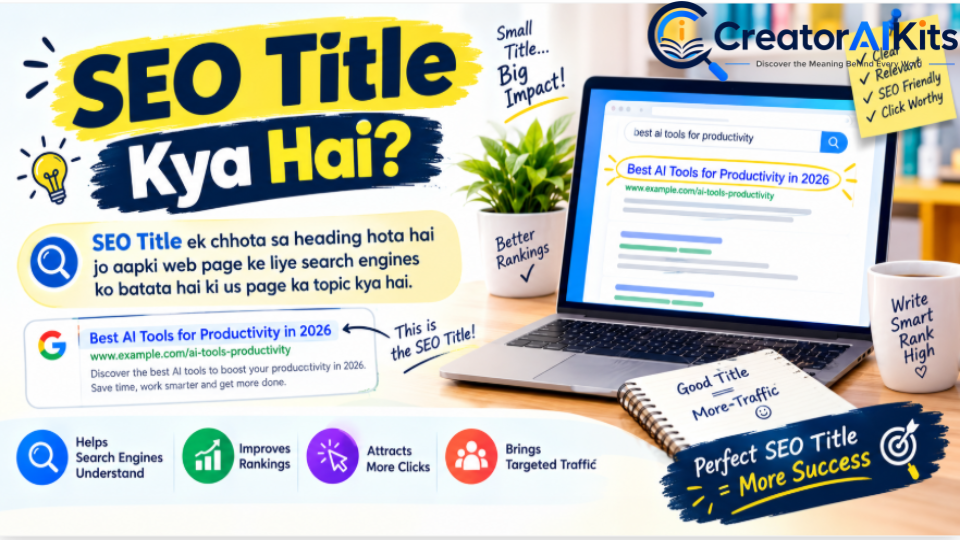
An SEO title, commonly called a title tag, is the HTML <title> element that helps describe the main topic of a webpage.
Google can use this information when generating the clickable title link that appears in Search. However, Google can also use other information from the page, including the main visual title, headings, prominent text, links, and other sources when generating the title shown in Search.
For example:
<title>SEO Title Kaise Likhe 2026 | Best Practices & Tips</title>
The title may also appear in the browser tab and can be used when someone bookmarks the page.
A good SEO title should accurately represent the page instead of trying to manipulate search engines with exaggerated claims.
SEO Title vs. Page Title (H1)
These two terms are often confused, but they are not exactly the same.
SEO Title / Title Tag
The SEO title is the HTML <title> element. It is primarily used by search engines and can also appear in browser tabs.
H1 / Page Title
The H1 is the main visible heading on your webpage.
For example:
SEO Title:
SEO Title Kaise Likhe 2026 | Best Practices, Examples & Tips
H1:
SEO Title Kaise Likhe 2026: Best Practices, Examples & Tips
Your SEO title and H1 do not always need to be identical, but they should clearly describe the same topic and satisfy the same search intent.
Keeping them closely aligned also makes the page easier for users to understand.
SEO Title Kyun Zaroori Hai?
An SEO title is important because it gives both search engines and users an immediate idea of what a page is about.
A well-written title can:
- Clearly communicate the page topic
- Match the user’s search intent
- Help users understand whether the result is relevant
- Make your result easier to scan in Search
- Provide useful context about the page
- Support a better overall search experience
However, one important point should always be remembered:
An SEO title alone cannot guarantee Google rankings.
Search visibility depends on many factors, including content quality, relevance, technical accessibility, competition, links, site structure, and Google’s ranking systems.
Think of your title as an important part of your SEO strategy—not a magic ranking formula.
What Is CTR?
CTR, or Click-Through Rate, measures how often people click your search result after seeing it.
For example:
If your page receives 1,000 impressions and 50 clicks:
CTR = 5%
A clear and relevant title can influence whether someone decides to click, but there is no universal CTR percentage that every website should achieve.
CTR can vary depending on:
- Search position
- Search intent
- Industry
- Query type
- Device
- SERP features
- Brand recognition
- Competition
Therefore, avoid promises such as “this title will increase CTR by 200%.”
Instead, use Google Search Console to evaluate your actual performance.
2026 Practical SEO Title Formula
A useful starting formula is:
[Primary Topic] + [Clear Benefit] + [Specific Detail]
For example:
SEO Title Kaise Likhe 2026 | Practical Tips & Examples
This formula contains three useful elements:
| Component | Example | Purpose |
| Primary Topic | SEO Title Kaise Likhe | Clearly communicates the main subject |
| Benefit | Practical Tips | Shows what the reader will learn |
| Specific Detail | 2026 / Examples | Adds context and scope |
You do not need to use every element in every title.
The best title is the one that accurately describes the actual page.
1. Use the Primary Keyword Naturally
Your primary keyword or main search phrase should describe what the page is actually about.
For this article, the main topic is:
SEO Title Kaise Likhe
Including this phrase naturally helps immediately communicate the subject.
However, you do not need to repeat the keyword multiple times.
Better:
SEO Title Kaise Likhe 2026 | Practical Tips & Examples
Avoid:
SEO Title Kaise Likhe | SEO Title Tips | SEO Title Guide | SEO Titles 2026
The second example is repetitive and unnatural.
Natural relevance is more important than keyword repetition.
2. Match Search Intent
Before writing your title, ask:
What does the person actually want when they search this query?
For example, someone searching:
“SEO title kaise likhe”
is probably looking for a guide, explanation, examples, or practical instructions.
Therefore, a suitable title could be:
SEO Title Kaise Likhe 2026 | Best Practices, Examples & Tips
The title immediately tells the searcher what they will find.
Search intent can generally include:
- Informational
- Commercial
- Transactional
- Navigational
- Comparison-based
Your title should reflect the intent of the page rather than trying to target every possible keyword.
3. Use Numbers Carefully
Numbers can make a title more specific and easier to scan.
Examples:
- 7 SEO Title Tips
- 10 Common SEO Mistakes
- 5 SEO Tools for Beginners
- 2026 SEO Guide
But only use a number when the article actually contains that number of items.
Good:
7 SEO Title Mistakes to Avoid in 2026
If the article genuinely covers seven mistakes.
Bad:
17 SEO Title Tips
when the article contains only five tips.
Accuracy should always come before click appeal.
4. Use Relevant Power Words
Some words can make a title clearer and more useful.
Clarity
- Complete
- Practical
- Step-by-Step
- Beginner-Friendly
Benefit
- Useful
- Effective
- Simple
- Practical
Freshness
- 2026
- Updated
- Latest
Specificity
- Beginner
- Advanced
- Free
- Examples
For example:
SEO Title Kaise Likhe 2026 | Practical Tips for Beginners
is clearer than:
SEO Titles
However, avoid exaggerated words such as:
- 100% Guaranteed
- #1 Guaranteed
- Secret Formula
- Instant Ranking
- Guaranteed Traffic
unless you have a legitimate reason to make such a claim.
For SEO content, accuracy and trust are more important than sensational wording.
5. Keep Every Page’s Title Unique
Each important page on your website should have a title that accurately describes its own content.
Avoid giving multiple pages nearly identical titles.
Weak:
- SEO Tips
- SEO Tips
- SEO Tips
Better:
- SEO Title Kaise Likhe 2026
- How to Write Meta Descriptions
- Keyword Research Guide for Beginners
- Internal Linking Guide for SEO
- Best AI SEO Tools in 2026
Unique titles help users understand the difference between your pages.
They also help you build a clearer topical structure across your website.
6. Write for People, Not Just Search Engines
Before publishing a title, ask yourself three questions:
- Is the topic immediately clear?
- Does the title match the search intent?
- Does the reader understand what they will get?
If the answer is yes to all three, your title has a strong foundation.
Do not write titles simply because a keyword tool gives them a high score.
Your real audience should remain the priority.
7. Use Your Brand Name When It Makes Sense
You can include your brand name when it adds value.
For example:
SEO Title Kaise Likhe 2026 | Practical Guide | CreatorAIKits
However, adding your brand is not necessary if it makes the title unnecessarily long.
For a newer website, it is often more important to make the actual topic immediately clear.
Use branding where it improves recognition without reducing clarity.
AEO and GEO for AI Search
AI-powered search has changed how people discover information.
You may have heard the terms:
- AEO
- GEO
- AI Search
- Generative Search
- AI Overviews
- AI Mode
But there is an important point to understand.
Google’s current guidance says that the foundational SEO practices used for normal Search remain relevant for AI features. There is no separate “magic title formula” that guarantees inclusion in AI-generated search results.
Therefore, instead of trying to manipulate AI systems, focus on creating useful, reliable, accessible, and well-structured content.
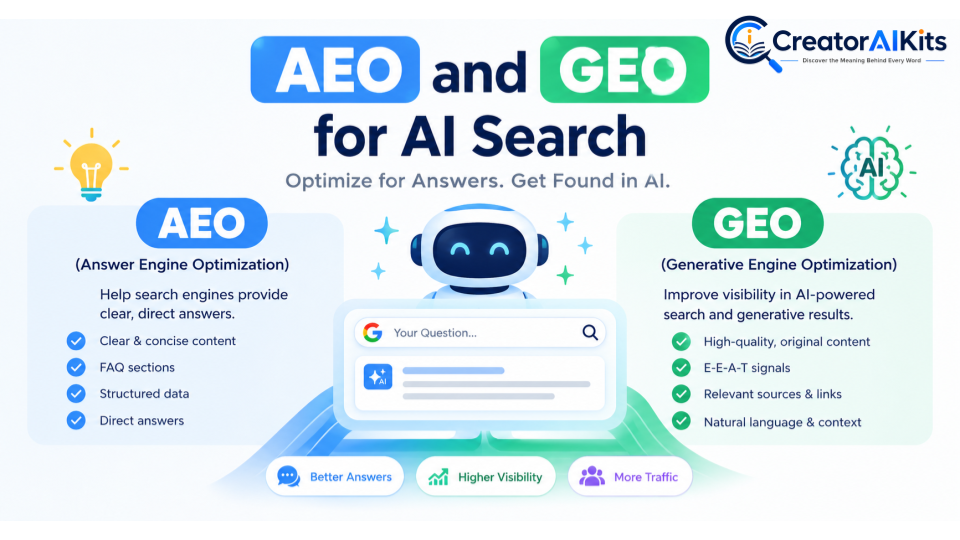
What Is AEO?
AEO commonly stands for:
Answer Engine Optimization
The general idea is to structure content so that users can quickly find clear answers to their questions.
For example:
What Is an SEO Title?
An SEO title is the HTML <title> element that describes the main topic of a webpage and can help search engines generate the title link shown in Search.
This structure is useful because the reader receives the answer immediately.
What Is GEO?
GEO commonly stands for:
Generative Engine Optimization
The term is often used when discussing visibility in AI-powered search and generative answer systems.
However, do not rely on supposed “GEO hacks.”
Avoid tactics such as:
- Fake citations
- Artificial mentions
- Keyword stuffing
- Repeated brand mentions
- Fake authority claims
- Promises that ChatGPT or another AI will cite your website
Instead, focus on:
- Helpful information
- Original insights
- Accurate facts
- Clear headings
- Direct answers
- Good website structure
- Relevant internal links
- Credible sources
- Genuine first-hand experience
- High-quality images when useful
Google’s current guidance specifically emphasizes valuable, original, people-first content and says there are no additional special requirements for appearing in AI Overviews or AI Mode beyond normal Search eligibility and best practices.
Pro Tip: Want to build a stronger content strategy around your SEO and AI search goals? Read our guide on How to Build an AI Content Strategy in 2026 for a practical, step-by-step approach to growing organic traffic.
E-E-A-T and Real Experience
E-E-A-T stands for:
- Experience
- Expertise
- Authoritativeness
- Trustworthiness
E-E-A-T should not be treated as a collection of buzzwords that you simply insert into an article.
The real goal is to demonstrate credibility through the content itself.
Experience
If you have personally tested an SEO tool, workflow, or method, you can explain what you actually tested and what you learned.
For example:
“I tested three different title formats and compared how clearly each one matched the intended search query.”
Only make this statement if you genuinely performed the test.
Do not create fictional experiments or personal success stories.
Expertise
You can demonstrate expertise through:
- Accurate explanations
- Correct terminology
- Practical examples
- Well-researched information
- Clear reasoning
- Relevant references
You do not need to call yourself an “SEO expert” repeatedly.
The quality of the information should demonstrate your knowledge.
Authoritativeness
Authority can be supported by:
- Reliable sources
- Relevant references
- Author information
- Consistent topical coverage
- Original research
- Genuine experience
Trustworthiness
Always check important claims before publishing.
If a statistic cannot be verified, remove it or clearly qualify it.
Avoid unsupported statements such as:
- “This guarantees #1 rankings.”
- “This formula always doubles traffic.”
- “Google officially recommends this exact title length.”
- “ChatGPT will definitely cite your website.”
Trustworthy content should be accurate even when the claim sounds less exciting.
10 Practical SEO Title Examples
Here are examples you can use as inspiration.
1. Beginner Guide
SEO Title Kaise Likhe 2026 | Practical Tips & Examples
2. Optimization Guide
SEO Title Optimization 2026 | Complete Beginner’s Guide
3. List-Based Article
7 SEO Title Mistakes to Avoid in 2026
4. CTR-Focused Article
How to Write SEO Titles for Better Click-Through Rates
5. AI Search Article
SEO Titles for AI Search | A Practical 2026 Guide
6. Educational Article
SEO Title Kya Hai? 2026 Beginner’s Guide
7. Comparison Article
SEO Title vs. Meta Description: What’s the Difference?
8. Tools Article
Best SEO Title Tools in 2026 | Free & Paid Options
9. Keyword-Focused Guide
How to Use Keywords in SEO Titles Without Stuffing
10. Practical Tutorial
How to Write an SEO Title: Formula, Examples & Tips
Do not copy these titles blindly. Adapt them to the actual topic and structure of your page.
Common SEO Title Mistakes
Mistake 1: Keyword Stuffing
Wrong:
SEO Title SEO Title Kaise Likhe SEO Title Tips SEO Title Guide 2026
This is repetitive and difficult to read.
Better:
SEO Title Kaise Likhe 2026 | Practical SEO Tips
Use the main topic naturally.
Mistake 2: Making the Title Unnecessarily Long
Wrong:
The Complete Ultimate Best SEO Title Guide That Will Teach You Everything About How to Write the Perfect SEO Title in 2026
Better:
SEO Title Kaise Likhe 2026 | Complete Practical Guide
There is no universal character limit that every title must meet.
Instead, make your title concise, descriptive, and relevant.
Google recommends descriptive and concise title text and may generate or modify title links using multiple sources from your page.
Mistake 3: Using a Generic Title
Weak:
SEO Tips
Better:
SEO Title Kaise Likhe 2026 | Practical Guide
The second title provides a much clearer expectation.
Mistake 4: Using Clickbait
Wrong:
Rank #1 on Google in One Day!
This creates an unrealistic promise.
Better:
SEO Title Kaise Likhe 2026 | Practical Optimization Guide
Your title should accurately represent what your article actually teaches.
Mistake 5: Adding Your Brand Unnecessarily
Less useful:
CreatorAIKits: SEO Title Kaise Likhe 2026 | Complete Guide to SEO Titles
Better:
SEO Title Kaise Likhe 2026 | Complete Guide | CreatorAIKits
And if the title is already long, you can leave the brand name out.
The topic should remain the most important part.
Best Tools for SEO Title Optimization
Free Tools
| Tool | Best For |
| Google Search Console | Monitoring impressions, clicks, CTR, queries, and search performance |
| Google Search | Studying real search results and competing titles |
| SERP Preview Tools | Checking how a title may appear |
| Character Counter | Basic length checking |
| AnswerThePublic | Finding questions and related topics |
For a beginner website, Google Search Console is especially useful because it gives you real performance data from your own website.
Do not rely only on third-party “SEO scores.”
Paid SEO Tools
| Tool | Best For |
| Ahrefs | Keyword research and competitor analysis |
| Semrush | SEO research and SERP analysis |
| Surfer | Content optimization workflows |
| Frase | Content research and optimization |
You do not need every paid tool.
Choose tools according to your actual SEO needs and budget.
SEO Title Comparison: Weak vs. Optimized
| Element | Weak Approach | Better Approach |
| Clarity | SEO Tips | SEO Title Kaise Likhe 2026 |
| Intent | Generic | Specific search intent |
| Relevance | Broad | Page-focused |
| Keyword use | Repeated | Natural |
| Benefit | Missing | Clearly communicated |
| Trust | Exaggerated | Accurate |
| User appeal | Unclear | Easy to understand |
The goal is not to create the most dramatic title.
The goal is to create the clearest and most relevant title for the searcher.
FAQ
What is an SEO title in 2026?
An SEO title is the HTML <title> element that describes a webpage. Google can use it when generating the clickable title link shown in Search, although Google may also use other page information.
What is the ideal SEO title length?
Google does not provide a universal fixed character limit that every title must follow.
Instead, keep your title concise, descriptive, and relevant. Avoid unnecessary words and make sure the title accurately represents the page.
Where should the primary keyword be placed?
Include your primary keyword naturally when it accurately describes the page.
Placing the main topic early can make the subject immediately clear, but there is no universal rule saying that the keyword must appear within the first three words.
Do numbers improve SEO titles?
Numbers can make titles more specific and easier to scan, especially for list-based content.
However, only use numbers that accurately represent the content.
How do I write an AEO-friendly title?
Start with the user’s actual question or search intent.
For example:
SEO Title Kya Hai? 2026 Beginner’s Guide
Then provide a clear, concise answer near the beginning of the article.
How do I write a GEO-friendly title?
There is no guaranteed GEO title formula.
Focus on clear titles, helpful original content, accurate information, logical structure, and established SEO best practices.
Can an SEO title guarantee a #1 Google ranking?
No.
An SEO title is only one part of SEO. Rankings depend on many factors and Google’s systems can change over time.
How many words should an SEO title contain?
There is no universal word-count requirement.
Write enough to clearly communicate the topic and value without adding unnecessary wording.
Should my SEO title and H1 be the same?
They can be the same, and keeping them closely aligned is often a simple approach.
They do not have to be identical, but they should clearly represent the same page topic and search intent.
Should I include 2026 in every SEO title?
No.
Use the year when it adds meaningful freshness or context. If the content is evergreen, adding a year may not always be necessary.
Conclusion: How to Write a Better SEO Title in 2026
Writing a strong SEO title does not require a secret formula.
Instead, focus on five principles:
- Clearly communicate the primary topic
- Match the user’s search intent
- Keep the title concise and descriptive
- Use keywords, numbers, and modifiers naturally
- Avoid unsupported claims, clickbait, and keyword stuffing
The most important principle is simple:
Write for the user first, then optimize for search.
Your title should help someone understand what your page is about before they click.
For AI-powered search, the same foundation remains important. Google recommends focusing on useful, original, reliable, people-first content and established SEO practices rather than trying to find special AEO or GEO hacks.
Pre-Publish SEO Checklist
Content Quality
- The primary topic is clearly represented in the title
- The H1 accurately describes the article
- The introduction answers the user’s main question quickly
- H2 and H3 headings follow a logical structure
- Sections are organized without unnecessary repetition
- Examples are relevant
- Tables provide useful information
- FAQs answer genuine questions
- The article adds useful value beyond basic repetition
- Unsupported claims have been removed or verified
On-Page SEO
- SEO title is descriptive and concise
- Meta description accurately summarizes the article
- URL is short and readable
- Primary topic appears naturally throughout the content
- Relevant internal links are included
- Credible external sources are referenced when appropriate
- Images are relevant and optimized
- Image alt text is descriptive
Technical SEO
- Page is indexable
- Canonical URL is correctly configured
- HTTPS is enabled
- Mobile experience has been checked
- Broken links have been checked
- Page speed and Core Web Vitals are monitored
- There is no accidental noindex
- URL can be inspected in Google Search Console
Google’s current guidance also emphasizes crawlability, internal linking, page experience, text accessibility, and accurate structured data for AI Search eligibility and overall Search performance.
What to Do After Publishing
Day 1
- Publish the article.
- Open Google Search Console.
- Inspect the URL.
- Check the indexing status.
- Add relevant internal links from older articles.
- Share the article on relevant social channels.
Days 2–7
- Monitor indexing.
- Check for technical problems.
- Review internal links.
- Make sure the page is accessible on mobile.
- Check for obvious formatting or content issues.
Days 8–30
- Monitor impressions in Search Console.
- Review the queries generating impressions.
- Monitor clicks and CTR.
- Look for queries that are closely related to your content.
- Improve the article only when there is a clear reason to do so.
Days 31–90
- Identify pages receiving impressions.
- Review new search queries.
- Find content gaps.
- Create relevant supporting articles.
- Improve internal linking.
- Update outdated information when necessary.
Important: There is no fixed 30-day, 60-day, or 90-day guarantee for rankings or traffic.
SEO performance varies according to competition, query intent, content quality, website authority, technical factors, and many other variables.
Bonus: Quick SEO Title Generator
Use this simple framework:
[Primary Topic] + [Benefit or Specific Detail] + [Year, If Relevant]
Examples
SEO Title Kaise Likhe | Practical Formula | 2026 Guide
Best SEO Titles | 7 Practical Tips for Better CTR
SEO Title Optimization | Complete Beginner’s Guide
Quick Formula
- Primary topic: Clearly describe the page
- Benefit: Tell readers what they will learn or gain
- Specific detail: Add useful context
- Year: Use it when freshness matters
- Brand: Optional
Remember:
Clarity > unnecessary length
Relevance > keyword stuffing
Accuracy > clickbait
Useful content > SEO tricks
Final Words
A strong SEO title is not about making unrealistic ranking promises.
Its real purpose is to clearly communicate three things:
What is this page about?
Who is it for?
What will the reader get from it?
In 2026, search is becoming increasingly AI-powered, but the fundamentals remain important: create useful, original, trustworthy, people-first content and follow established SEO best practices.
Instead of depending on a supposed “100% ranking formula,” use your own data to learn what works for your audience.
Your SEO Title Workflow
Research → Search Intent → Draft → Simplify → Verify → Publish → Measure → Improve
That is a more sustainable approach to SEO.
Best of luck with your SEO strategy!

Welcome to CreatorAIKits! I’m passionate about learning and exploring AI tools, creativity, and technology.
I’m continuously researching and gaining hands-on experience with different AI tools and technologies.
My goal is to share simple, useful, and practical AI information for beginners and everyday users.
Thanks for visiting CreatorAIKits!
A very helpful guide for anyone learning how to write SEO titles in 2026. I especially liked the practical tips and examples because they make it easier to understand how to create titles that are both search-friendly and appealing to readers. Great resource for improving on-page SEO!
Thank you so much for your kind words! I really appreciate you taking the time to read my article and share your feedback. 😊
A very useful and easy-to-follow guide on writing SEO titles in 2026. I especially liked the practical tips and examples because they make it easier to understand how to create titles that are both search-friendly and appealing to readers. Definitely a helpful resource for content creators and SEO beginners.
Thank you for your valuable comment! I’m glad you found the content helpful. Your feedback truly means a lot and motivates me to create more useful content. 🙌