
Writing great content can take hours, especially when you’re dealing with research, ideas, grammar, editing, and SEO at the same time. That’s why many writers, marketers, students, and business owners are turning to AI Powered Writing Tools to make the process faster and easier. The challenge is knowing which tools are actually useful and which ones may produce generic or unreliable content.
In this guide, we’ll explore how AI writing tools can support different stages of content creation, from generating ideas and drafting content to editing, improving readability, and optimizing copy. You’ll also learn what to look for when choosing an AI writing tool and how to use these tools responsibly while keeping your content accurate, original, and human-focused.
Best AI-Powered Writing Tools for Content Creation
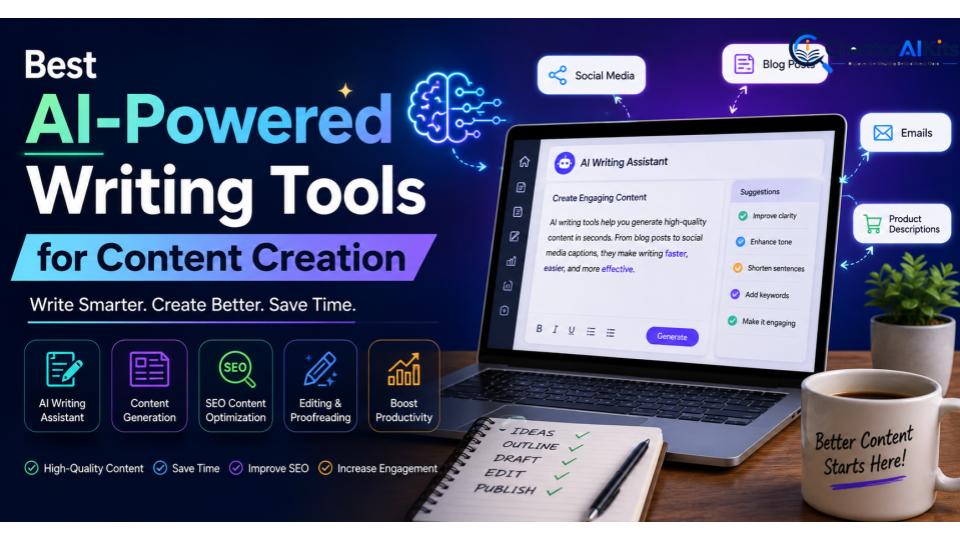
AI writing tools have become useful content creation tools for bloggers, marketers, students, businesses, and professional writers. They can help with everything from generating ideas and outlines to creating blog posts, emails, product descriptions, and social media content. Instead of treating AI as a complete replacement for a writer, it’s often more useful to think of it as a writing partner that helps you move faster.
Different platforms focus on different tasks. An AI text generator may be ideal for creating an initial draft, while an AI writing assistant may focus more on editing and writing improvement. Some platforms combine content generation with SEO writing tools, keyword research, proofreading, and content optimization. Choosing the right option depends on what you actually need to accomplish.
How AI-Powered Writing Tools Improve Your Writing
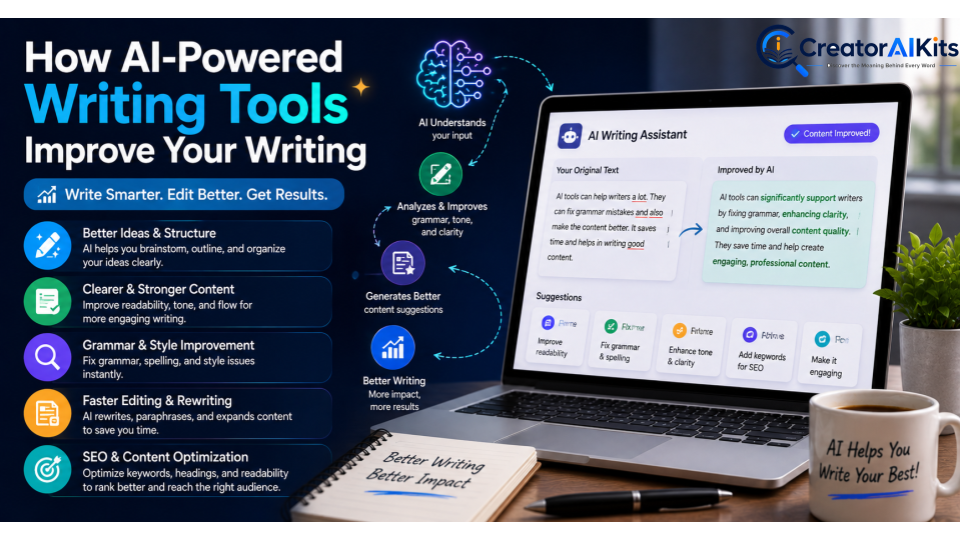
One of the biggest advantages of AI writing software is that it can reduce the time spent on repetitive writing tasks. For example, an AI writing assistant can help you rewrite an unclear sentence, expand a short idea, simplify complicated language, or adjust the tone of an email. These features can be especially helpful when you know what you want to say but struggle to express it clearly.
AI tools can also support proofreading and editing. A grammar checker can identify common language problems while a paraphrasing tool can suggest alternative wording. Some platforms also offer article summarization, text rewriting, and readability suggestions. Still, you shouldn’t accept every AI suggestion automatically. Human review remains important because context, accuracy, originality, and personal experience can be difficult for an automated system to judge correctly.
What to look for in AI Writing Tools
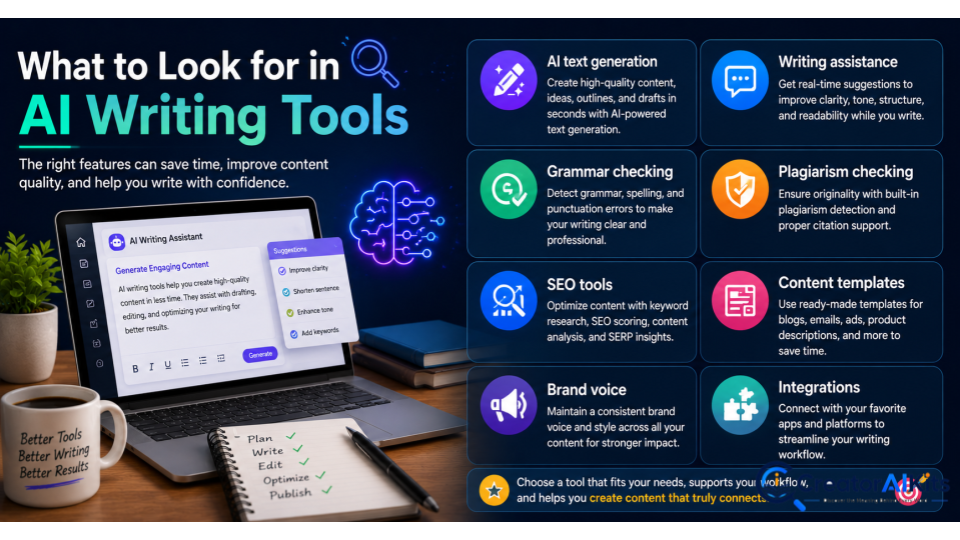
Not every AI writing tool offers the same features or quality. Before choosing one, consider the type of content you create and the problems you want the tool to solve. A blogger may need content planning and keyword research, while an ecommerce business may care more about product descriptions and marketing copywriting.
Look for features that match your workflow, such as useful content templates, a reliable grammar checker, plagiarism checking, editing options, integrations, and reasonable usage limits. If SEO matters to you, check whether the platform supports keyword analysis, keyword clusters, search intent, content briefs, or SEO scoring. The source material also identifies user-friendly interfaces, multiple text types, plagiarism checks, integrations, free plans, and keyword-cluster planning as important features to consider.
| Feature | Why It Matters |
| AI text generation | Helps create initial drafts and ideas |
| Writing assistance | Supports editing and improving existing content |
| Grammar checking | Helps identify language and grammar issues |
| Plagiarism checking | Helps review content originality |
| SEO tools | Supports keyword research and content optimization |
| Content templates | Speeds up common writing tasks |
| Brand voice | Helps maintain a consistent writing style |
| Integrations | Lets you use the tool within your existing workflow |
The most important point is to choose based on your actual needs rather than simply selecting the tool with the longest feature list. A simple tool that fits your workflow can be more useful than a powerful platform filled with features you never use.
Best AI Writing Tools in 2026 (Free & Paid)
The AI writing market has grown quickly, but the “best” tool depends on what you need to write. In 2026, general-purpose AI assistants such as ChatGPT and Claude compete with specialized platforms built for SEO, marketing, proofreading, and creative writing. Recent comparisons also show that tools perform differently across drafting, editing, brand voice, and specialized workflows.
For content creators, useful options include general AI text generators, SEO writing tools, and dedicated writing assistants. ChatGPT can help with brainstorming, research, outlines, and drafts, while tools such as Grammarly focus more on writing improvement. Specialized platforms can add features such as keyword analysis, content scoring, brand voice, and SEO content optimization. Your choice should therefore depend on your workflow rather than simply choosing the most popular name. The uploaded research also groups AI writing platforms around text generation, writing assistance, SEO, proofreading, research, and creative writing.
| Tool Type | Best Use | Useful Features |
| General AI assistant | Research and drafting | AI prompts, ideas, outlines |
| AI writing assistant | Editing and polishing | Grammar correction, rewriting, readability |
| SEO writing tool | Search-focused content | Keyword research, SERP analysis, content scoring |
| Marketing AI | Business content | Copywriting, emails, social media content |
| Creative writing tool | Stories and fiction | Brainstorming, plot ideas, creative editing |
How to Choose the Right AI Writing Tool
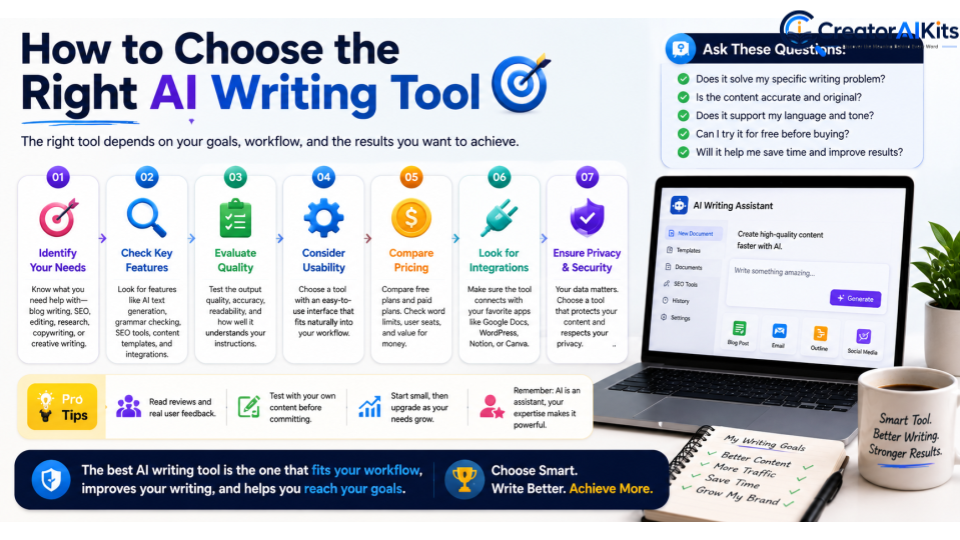
Choosing an AI writing tool becomes easier when you start with the task instead of the brand. If you mainly need help creating drafts, look for strong AI text generation and flexible prompts. If your biggest problem is polishing existing work, prioritize an AI writing assistant with grammar correction, readability suggestions, and text rewriting. For SEO projects, look for keyword research, keyword clustering, competitor analysis, and content planning features.
You should also consider your budget, writing volume, integrations, and the level of human control you want. A free plan can be enough for occasional writing, while a paid platform may make sense if you create content every day. Most importantly, don’t assume that AI-generated content is automatically accurate or original. Review important claims, verify sources, and edit the final draft so your expertise and voice remain visible. Current 2026 guidance similarly emphasizes choosing tools that fit an existing workflow while maintaining quality, branding, and voice.
Best AI Writing Tools for Students and Professionals
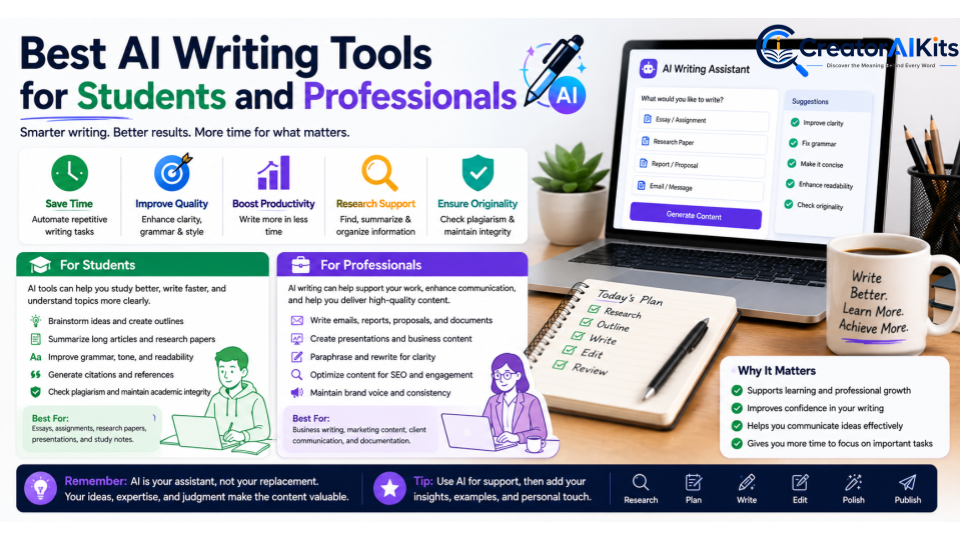
Students can use AI writing tools for brainstorming, outlining, summarizing difficult material, improving readability, and checking grammar. Professionals may use them for reports, emails, presentations, proposals, research notes, and business communication. However, users should follow their school or workplace rules and remain responsible for the accuracy and originality of submitted work.
For academic and professional writing, AI should support your thinking rather than replace it. Research on AI-supported student writing suggests that well-designed writing assistance can support writer agency and deeper engagement when users remain involved in the writing process. Tools that provide citations, editing suggestions, research support, and structured feedback can be especially useful when accuracy matters. Your own judgment should always have the final say.
AI Writing Assistants for Faster Content Creation
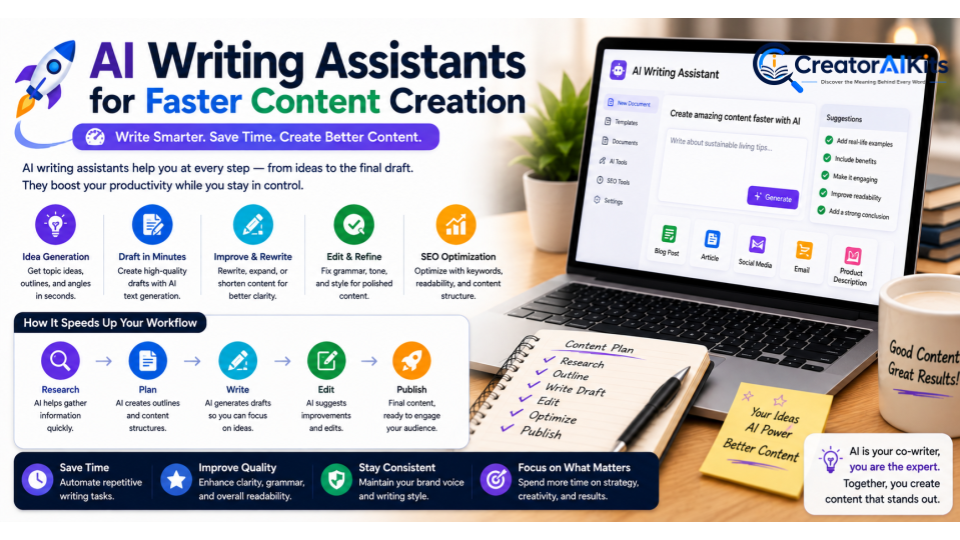
An AI writing assistant can help you move through the writing process without constantly starting from scratch. You can use it to brainstorm a topic, create a content brief, suggest headings, rewrite awkward sentences, expand short sections, or adjust the tone for a particular audience. This can make repetitive tasks much faster while giving you more time to focus on ideas and strategy.
The strongest workflow is usually a human-AI partnership. Give the tool clear AI prompts and useful context, review its output, fact-check important information, and then add your own experience and perspective. AI can help with speed and structure, but human writers still provide judgment, originality, context, and accountability. Current research on AI-assisted writing also highlights the importance of maintaining writer control rather than treating AI as a substitute for the author.
FAQs
What are AI Powered Writing Tools?
They are software tools that use AI to help generate, edit, summarize, rewrite, or improve written content.
Which AI writing tool is best in 2026?
There isn’t one best option for everyone. The right tool depends on whether you need research, SEO, editing, marketing, or creative writing support.
Can AI writing tools improve SEO content?
Yes. Some tools support keyword research, SERP analysis, content briefs, semantic analysis, and content optimization.
Are AI writing tools free?
Many offer free plans or limited free access, while advanced features often require a paid subscription.
Can AI writing tools replace human writers?
They can automate parts of the writing process, but human review remains important for accuracy, originality, context, and personal expertise.
Conclusion
AI writing tools can make content creation faster, more organized, and easier to manage. From brainstorming and research to editing, SEO, and final polishing, the right platform can support almost every stage of your workflow. However, the best results come when you combine AI assistance with human judgment.
When choosing AI Powered Writing Tools, focus on your specific goals instead of chasing every new feature. Test the available options, compare their strengths and limitations, and choose the one that helps you produce accurate, useful, and genuinely valuable content.

Welcome to CreatorAIKits! I’m passionate about learning and exploring AI tools, creativity, and technology.
I’m continuously researching and gaining hands-on experience with different AI tools and technologies.
My goal is to share simple, useful, and practical AI information for beginners and everyday users.
Thanks for visiting CreatorAIKits!