

The AI search landscape is changing rapidly, but publishing an article about every new AI tool, feature, or product launch is not a sustainable SEO strategy.
Thousands of AI tools are launched, updated, merged, or replaced every year. The websites most likely to build lasting organic visibility are not necessarily the ones publishing the most AI news. They are the ones consistently helping people solve problems, compare solutions, and accomplish specific tasks.
For example, someone searching for “best AI tools for students,” “ChatGPT alternatives for writers,” or “how to automate social media with AI” is not simply looking for information about artificial intelligence. They have a goal.
They may want to:
- Find the right tool for a specific job
- Compare several AI platforms
- Replace an existing tool
- Save time or money
- Automate a repetitive task
- Learn how to complete something with AI
- Decide whether an AI product is worth using
That is where a strong AI content strategy becomes valuable.
Instead of building your website around individual AI tool launches, build it around search intent, real user problems, practical outcomes, and connected topics.
Google’s current guidance continues to emphasize helpful, reliable, people-first content rather than content created primarily to manipulate search rankings. Google also says there is no special optimization or markup required specifically for AI Overviews or AI Mode; strong SEO fundamentals remain important.
The most effective AI content strategy can be organized around three high-intent content pillars:
- AI for X — Content designed for specific audiences, professions, tasks, and use cases.
- Comparisons & Alternatives — Content that helps users evaluate competing AI solutions.
- How-To & Problem-Solving Content — Practical guides that show users exactly how to accomplish a task with AI.
But these are more than simple content categories.
When connected properly, they can form a topic cluster that attracts users at different stages of the search journey—from discovering a problem to comparing solutions and finally taking action.
Let’s look at how to build each pillar.
What Is an AI Content Strategy?
An AI content strategy is a structured plan for creating and organizing content around the problems, questions, tasks, and decisions people have when using artificial intelligence.
Instead of asking:
“Which AI keyword should I write about?”
A better question is:
“What does my target reader want to accomplish with AI, and what information would genuinely help them?”
That shift is important.
Google’s people-first guidance encourages publishers to create content that provides substantial value, demonstrates knowledge or experience where appropriate, and leaves readers satisfied rather than forcing them to search again for a better answer.
For an AI-focused website, this means your content should ideally do more than repeat information already available on an AI company’s website.
You can add value through:
- Practical comparisons
- Original analysis
- Clear use cases
- Step-by-step workflows
- Pros and cons
- Pricing explanations
- Feature comparisons
- Real-world examples
- Tool recommendations based on specific needs
- Screenshots or demonstrations where appropriate
- Updated information when products change
The goal is not simply to publish more content.
The goal is to build useful content that deserves to be found.
Pillar 1: AI for X — Target Specific Audiences and Use Cases
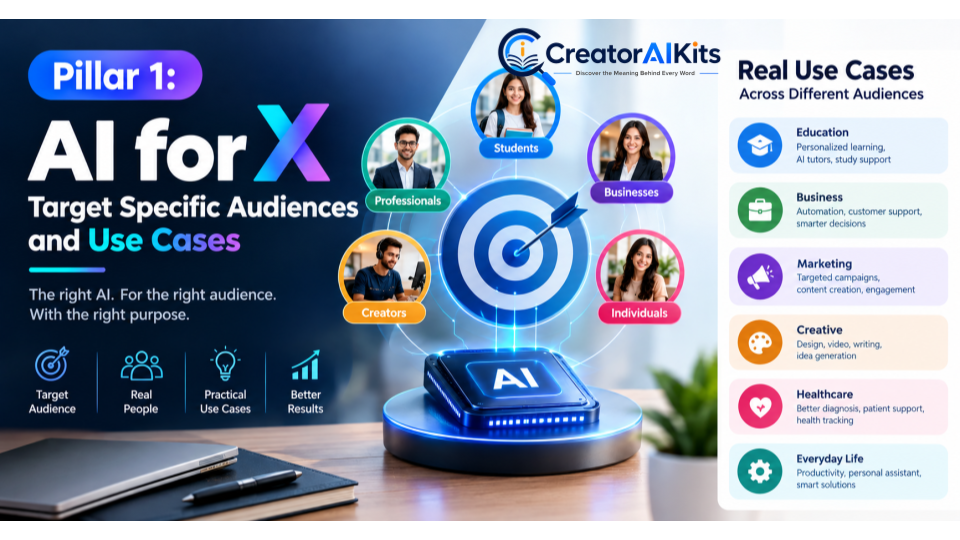
The first content pillar focuses on who needs AI and what they want to accomplish with it.
Instead of writing broadly about an AI tool, create content around a specific audience, profession, task, or use case.
For example:
- Best AI Tools for Students
- Best AI Tools for Content Creators
- Best AI Tools for Freelancers
- Best AI Tools for Small Businesses
- Best AI Tools for Social Media Managers
- Best AI Tools for Writers
- Best AI Tools for Recruiters
- Best AI Tools for Teachers
- Best AI Tools for E-commerce Businesses
This approach works because the searcher already has a clear need.
Someone searching for “best AI tools for content creators” has a much clearer intent than someone searching for simply “AI tools.”
Why AI-for-X Content Has Strong Intent
Specific audience-based searches often reveal the user’s context.
A student may care about:
- Research
- Summarization
- Note-taking
- Studying
- Writing assistance
- Presentation creation
A social media manager may care about:
- Content generation
- Scheduling
- Image creation
- Video editing
- Analytics
- Repurposing content
A freelancer may care about:
- Client communication
- Proposal writing
- Research
- Productivity
- Automation
- Content creation
This gives you an opportunity to create highly relevant content rather than generic AI lists.
How to Build an AI-for-X Article
A strong article can follow this structure:
H1: Best AI Tools for Content Creators in 2026
Introduction: Answer the searcher’s question quickly.
Quick comparison table: Tool, best for, key feature, pricing.
Individual tool sections: Explain who each tool is best for and why.
Use-case recommendations: Help readers choose based on their specific needs.
Pros and cons: Give balanced information.
FAQs: Address common questions.
Conclusion: Provide a clear recommendation.
You can then create supporting articles around the same audience.
For example:
Main topic:
Best AI Tools for Content Creators
Supporting topics:
- Best AI Video Generators for Content Creators
- Best AI Writing Tools for Bloggers
- Best AI Image Generators for Social Media
- Best AI Tools for YouTube Creators
- How to Use AI to Repurpose Content
- Best AI Tools for Creating Social Media Posts
These pages can be internally linked to one another, creating a connected topic cluster.
Google specifically recommends making important content discoverable through internal links, while its AI-search guidance says the same foundational SEO practices remain relevant for AI features.
Pillar 2: Comparisons & Alternatives — Help Users Make Better Decisions
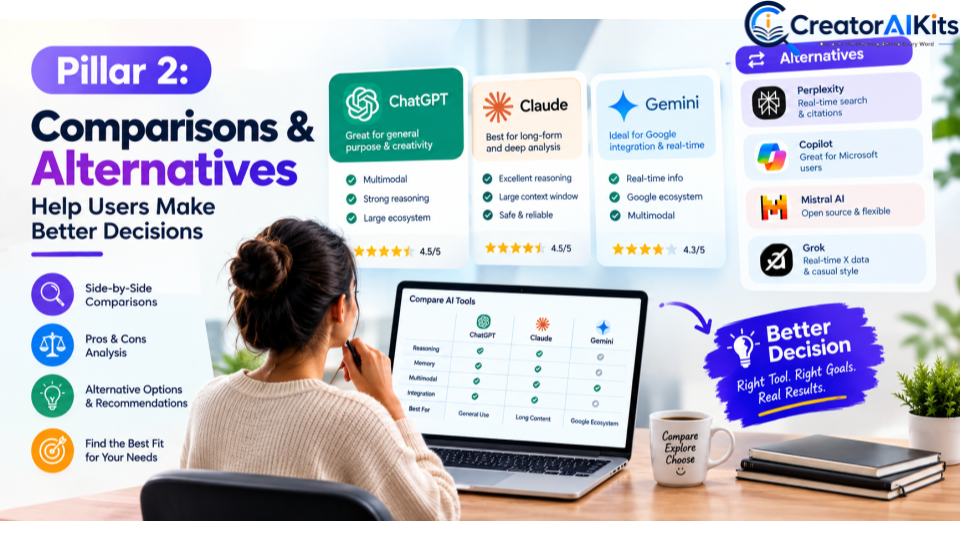
The second pillar focuses on comparison and decision-making intent.
This is one of the most valuable types of content for an AI website because users searching for comparisons are often already considering a product.
Examples include:
- ChatGPT vs Claude
- Claude vs Gemini
- ChatGPT Alternatives
- Best ChatGPT Alternatives for Writers
- Canva vs Adobe Express
- Notion AI vs ChatGPT
- Best AI Presentation Tools
- Best AI Writing Tools for Bloggers
- Best Free AI Tools for Students
The user is no longer asking:
“What is AI?”
They are asking:
“Which option should I choose?”
That is a much more commercially meaningful question.
How to Create Better Comparison Content
A weak comparison simply lists features.
A stronger comparison helps the reader make a decision.
For example, instead of:
ChatGPT has feature A. Claude has feature B. Gemini has feature C.
Build the article around actual decision criteria:
| Feature | Tool A | Tool B | Tool C |
| Best for | Writing | Research | Productivity |
| Free plan | Yes | Yes | Yes |
| Advanced features | Yes | Yes | Yes |
| Ease of use | High | High | High |
| Best use case | Content | Long documents | Google ecosystem |
Instead of declaring one universal winner, make recommendations according to user needs.
For example:
- Best overall: Tool A
- Best for long-form writing: Tool B
- Best for research: Tool C
- Best budget option: Tool D
- Best for beginners: Tool E
This makes the article more useful because different readers have different priorities.
Alternatives Content
“Alternative” searches are particularly useful because they indicate that the user already knows about a product but is looking for another option.
Examples:
- Best ChatGPT Alternatives
- Best Canva Alternatives
- Best Midjourney Alternatives
- Best Notion AI Alternatives
- Best AI Writing Alternatives to Jasper
A good alternatives article should explain why someone might want an alternative in the first place.
Possible reasons include:
- Pricing
- Missing features
- Ease of use
- Privacy requirements
- Different workflows
- Better collaboration
- Better integrations
- Specific professional needs
Avoid creating thin “X alternatives” pages that simply replace one product name with another. Google warns against producing large quantities of low-value pages primarily to manipulate search rankings.
Instead, each comparison should provide genuine analysis and help the reader make a better decision.
Pillar 3: How-To & Problem-Solving Content
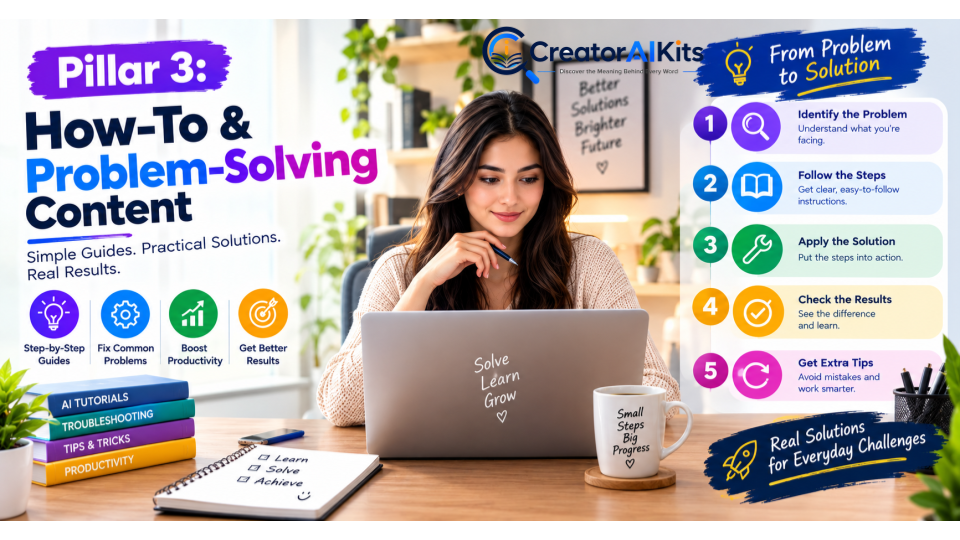
The third pillar focuses on actionable searches.
These are searches where the user wants to accomplish something.
Examples:
- How to use ChatGPT for SEO
- How to create a presentation with AI
- How to summarize a PDF with AI
- How to automate social media with AI
- How to create YouTube videos with AI
- How to use AI for keyword research
- How to create blog posts with AI
- How to turn a blog post into social media content with AI
These topics can be extremely valuable because they address a specific problem.
Why How-To Content Matters
A person searching:
“How to automate social media with AI”
doesn’t necessarily care about learning every detail about artificial intelligence.
They want a result.
They want to know:
- Which tools they need
- How the workflow works
- How to set it up
- What can be automated
- What should remain manual
- What the process costs
- What mistakes to avoid
That gives you an opportunity to provide significantly more value than a generic AI article.
How to Structure a High-Quality AI How-To Article
A practical structure might look like this:
Step 1: Explain the Goal
Tell readers exactly what they will achieve.
Step 2: List the Tools Required
Explain which AI tools or platforms are needed.
Step 3: Provide the Workflow
Show the process in logical steps.
Step 4: Include Examples
Give readers prompts, examples, templates, or realistic use cases where appropriate.
Step 5: Explain Common Mistakes
Tell readers what can go wrong and how to avoid it.
Step 6: Provide a Faster Alternative
If there is a simpler workflow, explain it.
Step 7: Summarize the Results
Show readers what they should have achieved by the end.
This structure makes the article useful even for readers who have never used the technology before.
How These Three Content Pillars Work Together
The real power of this strategy comes from combining the three pillars rather than publishing them independently.
Imagine you want to build authority around AI for content creators.
You could create a content ecosystem like this:
Pillar Topic
Best AI Tools for Content Creators in 2026
Then create comparison content:
- ChatGPT vs Claude for Content Writing
- Best AI Writing Tools for Bloggers
- Best AI Video Tools for YouTube
- Best AI Image Generators for Social Media
Then create how-to content:
- How to Use AI to Create a Blog Post
- How to Repurpose a Blog Post Into Social Media Content
- How to Create YouTube Scripts With AI
- How to Generate Social Media Ideas With AI
Finally, connect these pages using relevant internal links.
The result is no longer a collection of random AI articles.
It becomes a topic cluster.
Search Intent Should Guide Every Article
Before writing an article, identify the primary search intent.
A simple framework is:
| Search Intent | What the User Wants | Example |
| Informational | Learn something | What is generative AI? |
| Commercial investigation | Compare options | Best AI writing tools |
| Comparison | Evaluate products | ChatGPT vs Claude |
| Alternative | Find another solution | ChatGPT alternatives |
| Transactional | Take action | ChatGPT pricing |
| How-to | Complete a task | How to use AI for SEO |
The same keyword can sometimes have multiple interpretations, so examine the actual search results and the questions users are asking.
Don’t force a keyword into an article type simply because it has attractive search volume.
Intent comes first.
Google’s SEO guidance recommends thinking about the words people actually use to search for content, while also noting that Google’s language systems can understand related queries without requiring exact keyword repetition.
Use Keywords Naturally — Don’t Stuff Them
Keywords still matter because they help describe what your page is about, but modern SEO is not about repeating the same phrase dozens of times.
For example, if your primary keyword is:
AI tools for students
you don’t need to write:
AI tools for students are useful because AI tools for students help students…
Instead, naturally cover related concepts such as:
- AI study tools
- AI note-taking tools
- AI research assistants
- AI writing tools
- AI productivity tools
- AI tools for college students
- AI tools for exam preparation
The content should sound natural to a human reader.
Google’s Search Essentials recommends using words people would use to find your content in prominent areas such as the title and main heading, while Google’s language systems can understand related queries and variations.
Build Content Around Topics, Not Just Keywords
One of the biggest mistakes in AI SEO is treating every keyword as a separate article.
Instead, think in terms of topics and relationships.
For example:
Main topic: AI Tools for Freelancers
Supporting topics:
- Best AI Writing Tools for Freelancers
- Best AI Proposal Generators
- Best AI Meeting Assistants
- Best AI Research Tools
- Best AI Productivity Tools
- How to Automate Freelance Client Work
- ChatGPT vs Claude for Freelancers
Each article serves a different search need, but together they build a stronger topical ecosystem.
This also creates natural opportunities for internal linking.
Make Your AI Content More Trustworthy
AI content is now extremely easy to produce. That means simply publishing another generic AI article is unlikely to provide enough differentiation.
Your advantage should come from quality, evidence, experience, and useful analysis.
For each article, ask:
1. Is the information accurate?
AI products change quickly. Verify important features, pricing, availability, and product claims before publishing.
2. Is there original value?
Don’t simply rewrite another website’s article.
Add:
- Your own analysis
- Practical examples
- Clear comparisons
- Useful recommendations
- Original screenshots or demonstrations when appropriate
- Testing observations when you genuinely tested a product
3. Is the author clear?
Use a visible author name and an appropriate author/profile page.
Google’s people-first guidance specifically encourages clear authorship and information that helps readers understand who created the content.
4. Are your sources trustworthy?
When discussing product specifications, pricing, research, or important claims, prioritize authoritative sources and link to primary sources when appropriate.
5. Is the article actually useful?
Ask yourself:
“If this article disappeared from Google tomorrow, would a reader genuinely miss it?”
If the answer is no, the content probably needs more original value.
AI Content and Google Search: What You Should Know in 2026
AI-assisted content itself is not the problem.
The important issue is how the content is created and why it exists.
Google’s current guidance says AI or automation can be used to assist content creation, but content should still meet Google’s quality and spam policies. Google specifically warns against scaled content created primarily to manipulate rankings, including large amounts of unoriginal content produced with generative AI.
For an AI website, this means:
Don’t do this:
- Generate hundreds of near-identical AI articles
- Rewrite competitors without adding value
- Create pages only because a keyword exists
- Publish outdated AI tool information
- Produce thin comparison pages
- Create dozens of variations targeting tiny keyword differences
Do this instead:
- Research before writing
- Verify important facts
- Add original analysis
- Demonstrate practical knowledge
- Explain real use cases
- Link related articles
- Update articles when products change
- Write primarily for people
Google’s guidance is clear: the goal should be content that helps visitors, not content produced primarily to attract search-engine traffic.
Optimize for AI Overviews and AI Mode Without Chasing “AI SEO Tricks”
Google’s AI Overviews and AI Mode are changing how people discover information, but there is no separate secret optimization formula required to appear in them.
Google states that the foundational SEO practices used for traditional Search remain relevant to AI features. Pages need to be crawlable, indexable, and eligible to appear in Search, while content should be helpful, reliable, and people-first.
That means you should focus on:
- Clear answers
- Helpful headings
- Well-structured content
- Original information
- Strong internal linking
- Relevant images and media
- Good page experience
- Accurate information
- Clear authorship
- Search-friendly titles
- Accessible text content
Don’t waste time creating imaginary “AI ranking hacks.”
Build the best answer you can.
Google’s own 2026 generative-AI guidance emphasizes valuable, unique, non-commodity content and warns that producing large numbers of pages simply to target variations of search queries can fall into scaled-content abuse.
A Simple AI Content Strategy You Can Follow
If you’re starting or growing an AI website, you don’t need to publish dozens of random articles every week.
Start with a focused system.
Step 1: Choose Your Audience
For example:
- Students
- Content creators
- Freelancers
- Small businesses
- Marketers
- Bloggers
Step 2: Identify Their Problems
Ask:
- What do they struggle with?
- What tasks take too long?
- What decisions do they need to make?
- Which AI tools could help?
Step 3: Create One Main Pillar Article
For example:
Best AI Tools for Freelancers in 2026
Step 4: Create Supporting Comparison Content
Examples:
- ChatGPT vs Claude for Freelancers
- Best AI Writing Tools for Freelancers
- Best AI Research Tools for Freelancers
Step 5: Create Supporting How-To Content
Examples:
- How to Use AI for Freelance Proposals
- How to Automate Client Research With AI
- How to Use AI to Save Time on Freelance Work
Step 6: Connect Everything
Use relevant internal links between the articles.
Step 7: Improve Existing Content
Don’t assume publishing a new article is always better than improving an existing one.
Update:
- Outdated prices
- Old features
- Broken links
- Screenshots
- Tool availability
- Examples
- Comparison tables
- FAQs
This creates a website that becomes more useful over time.
AI Content Strategy Checklist for 2026
Before publishing an AI-focused article, ask yourself:
Search Intent
- Does the article answer the actual search intent?
- Is the main question answered early?
- Does the content match what the reader wants to accomplish?
Content Quality
- Does the article provide original value?
- Have important facts been verified?
- Is the information genuinely useful?
- Have you avoided unnecessary repetition?
SEO
- Is the primary topic clear from the title and heading?
- Are related terms used naturally?
- Are relevant internal links included?
- Is the page easy to navigate?
- Are images optimized and relevant?
Trust
- Is the author clearly identified?
- Are important claims supported by reliable sources?
- Have you explained limitations where necessary?
- Are product features and pricing current?
AI Search
- Is the page crawlable and indexable?
- Does the content provide a direct, useful answer?
- Does it offer information beyond generic summaries?
- Would the article still be valuable if someone discovered it outside Google?
People-First Test
Finally, ask:
“Would I recommend this article to someone even if Google did not exist?”
If the answer is yes, you’re probably moving in the right direction.
Frequently Asked Questions
What is an AI content strategy?
An AI content strategy is a structured approach to creating content around the problems, questions, tasks, and decisions people have when using AI. Instead of publishing random AI topics, it organizes content around specific audiences, comparisons, use cases, and practical solutions.
What are the best AI content pillars for SEO?
Three strong pillars are AI for specific audiences and use cases, comparisons and alternatives, and how-to/problem-solving content. Together, they can cover discovery, evaluation, and action-oriented search intent.
Should I write about every new AI tool?
No. Publishing every AI launch is not necessarily a sustainable SEO strategy. Focus on tools and topics that are genuinely relevant to your audience and provide useful analysis, comparisons, or practical guidance.
Does AI-generated content rank on Google?
AI-assisted content can appear in Google Search, but Google evaluates content based on its usefulness, quality, relevance, and compliance with Search policies. Automatically generating large amounts of unoriginal content primarily to manipulate rankings can violate Google’s spam policies.
How can I optimize content for AI Overviews?
There is no special AI Overview optimization or special schema required. Google recommends following the same fundamental SEO practices: create helpful, reliable, people-first content, make pages accessible to Google, use internal links, provide important information in text, and maintain good page experience.
How many AI articles should I publish per week?
There is no universal number that guarantees better rankings. Quality and usefulness are more important than publishing volume. A smaller number of well-researched, connected articles can be more valuable than a large collection of thin pages.
Should every article target a separate keyword?
Not necessarily. Modern search systems can understand related queries and concepts. Build content around topics and user needs rather than creating separate pages for every tiny keyword variation.
What is the most important part of an AI SEO strategy?
The most important part is creating content that genuinely helps a specific audience accomplish something. Keywords, internal links, technical SEO, and content structure support that goal—but they cannot replace useful, trustworthy information.
Conclusion: Build an AI Content Ecosystem, Not an AI Content Factory
The future of AI SEO is not about publishing the largest number of AI articles.
It is about building a website that consistently helps people make better decisions and solve real problems with artificial intelligence.
The three content pillars provide a simple framework:
1. AI for X — Create content for specific audiences, professions, tasks, and use cases.
2. Comparisons & Alternatives — Help users evaluate AI products and choose the right solution for their needs.
3. How-To & Problem-Solving — Show readers how to use AI to accomplish specific tasks.
When these pillars are connected through relevant internal links, they can become a powerful content ecosystem rather than a collection of unrelated articles.
Most importantly, keep the focus on the reader.
Don’t create an article simply because a keyword has search volume. Don’t publish dozens of pages just because AI makes content production easy. And don’t chase every new “AI SEO trick.”
Instead, ask a simpler question:
What problem is my reader trying to solve, and can my article provide the clearest, most useful answer?
That is the foundation of a sustainable AI content strategy in 2026.
And in an increasingly AI-driven search environment, being genuinely useful is still one of the strongest strategies you can build around.

Welcome to CreatorAIKits! I’m passionate about learning and exploring AI tools, creativity, and technology.
I’m continuously researching and gaining hands-on experience with different AI tools and technologies.
My goal is to share simple, useful, and practical AI information for beginners and everyday users.
Thanks for visiting CreatorAIKits!